Tuesday, July 16, 2013

From Sandhills to Sand Dunes, Wildflower Surprises

On a recent ramble through the Sandhills, we paused to ponder this pastoral panorama from a rural roadside. As our focus shifted from the vast vistas to the verdant vegetation at our feet, we spied a pair of fantastic flowering plants.


A mass of bright pink petals rose a foot or more above the berry-laden blackberry bushes lining the ditch.


 And just a few steps farther along, a dazzling white counterpart. Breathtakingly beautiful; unnamed yet not altogether unfamiliar; the not-phlox, not-soapwort, not-meadow beauty posed patiently for picture after picture.


As the glorious pink and white petals flashed like bee and butterfly beacons in the bright midday sun, the flowers' reproductive organs thrust upward and outward, eager to embrace the pollinators upon their arrival. Such striking and distinctive flowers should not be too difficult to identify. 


 One of the joys of Hoot Owl Karma is the quest for additional knowledge which follows the time in the field. Perusing field guides, comparing notes with kindred spirits, or perhaps cutting corners when a deadline looms and consulting the oracle of Google Images can greatly expand the amateur naturalist's vocabulary and familiarity with the natural world.  In this case, the oracle suggested that our mystery plants belonged to the Gentian family, genus Sabatia. Our lovely ladies closely resembled a couple of the dozen or more species of Sabatia referred to variously as rose pinks or rose gentians. 

Alas, the quest for more definitive solutions to our mystery went by the wayside as more the more pedestrian concerns of earning a living encroached once again upon our limited time...

Fast forward to a brief getaway to the coast on the weekend just past, about three hours east of our abode near the fall line in central North Carolina. As Hunter and I stood by the boat ramp and admired the rapid advance of a squall across Bogue Sound in Carteret County, we spied somewhat familiar petals of pink in the edge of the salt marsh, right along the high tide line.

Rose gentians, perhaps?! Much less densely flowering than their piedmont kin and a much hotter pink, but the greatest distinction lay in the unnaturally bright star-like pattern at the heart of the flower.


Such a distinctive flower should be a cinch to identify to species; but that can wait. For now, we're content to ponder how it is that we've stood in this very same spot dozens of times over the years and never before noticed these nameless natural treasures.


Do yourself a favor. Go outside. Take a look around. 


Nature might just show you something new...

Monday, July 8, 2013

Biting Off More Than You Can Chew?

Came upon this little brown land snail in Weymouth Woods. 
Apparently ordinary little brown land snail, lolling alongside the remnants of a rather large toadstool.


Wait just a cotton-picking minute! This is atrocious!
What kind of beast rips off hunks of food the size of its own body?!

Sunday, July 7, 2013

Ephemera - The Black Swallowtail

At the pond the day winds down. Along the bank, a mass of tender greens, lush beneath delicate parasols of lacy white. A member of the family Apiaceae, first cousin to the wild carrots and dills and parsleys, 


and the universe of the larval Black Swallowtail.


Eggs laid and hatched, and few weeks worth of delicate foliage devoured, the larvae are nearly prepared to depart this little world.


Such exquisite ephemera. 


What do we make of a life so beautifully brief? 
Three generations elapsed in a single passage of our little globe around its sun. 


One fleeting moment. To be born, to live, to die.


Time perhaps for an acquaintance or two.


Growing. 


Changing.


Then, sunset.


Another day nearly done.


So Soon?


Saturday, July 6, 2013

Beauty in the Mud...

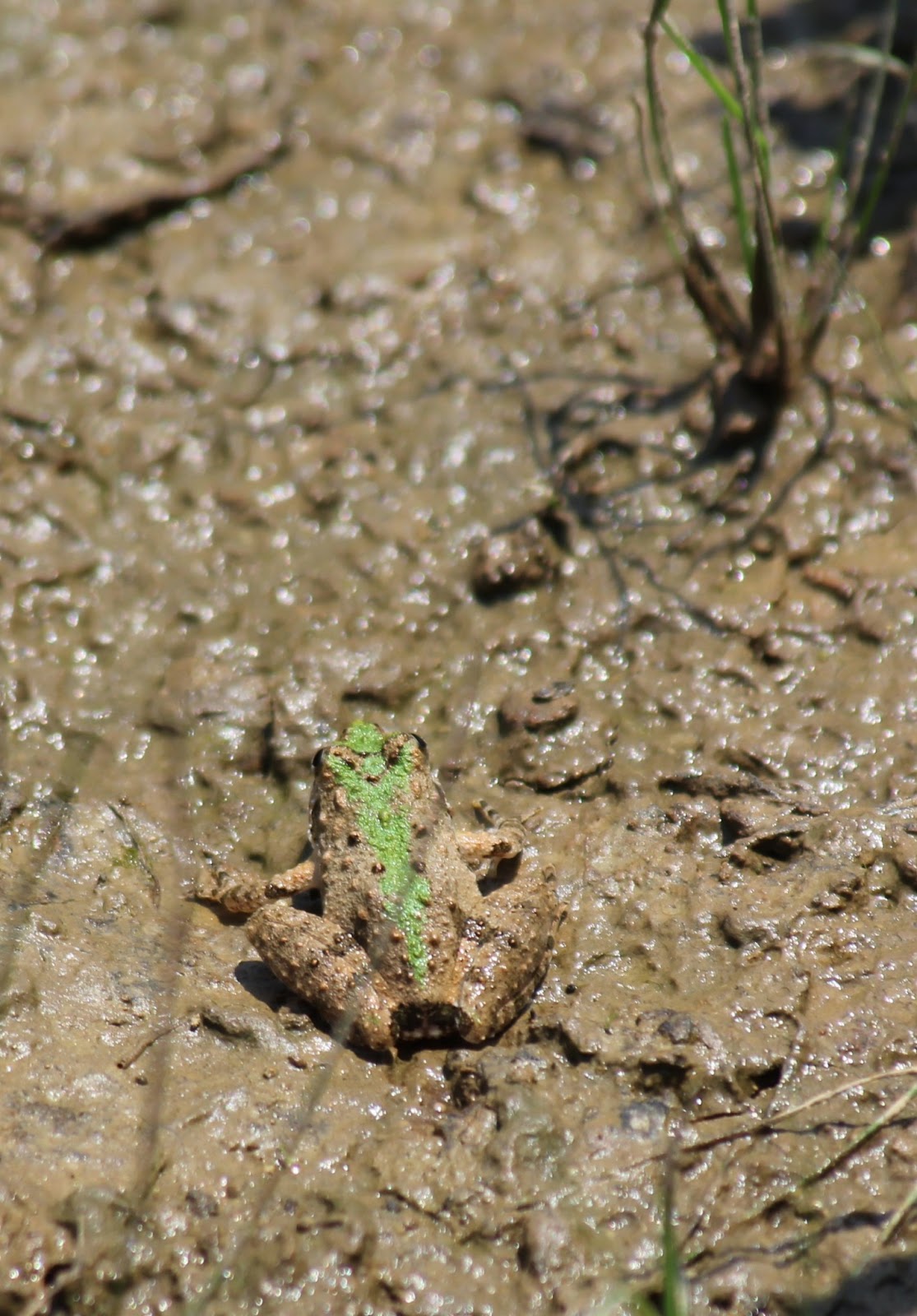
Meandering along the margins of a small municipal pond, Hunter's eyes were drawn to the muddy shallows by a bevy of brilliant butterflies, then a perfect pair of papillon apparently mining minerals from the miry muck.


 Allowing his eyes to linger, he spotted movement - another life, cooling it here in the sunlit mud. It took a moment, but soon it separated itself from the surrounding sameness and became a frog. A bumby, jumpy little northern cricket of a frog. 
Do you see it? 
There, just below and to the left of the leafy green weed in the center!


Once it wants to be seen, it's hard not to see it.


Then others appear. Brothers, sisters, a cousin perhaps? 


The once-barren mud flats are becoming downright crowded... 


Ah, here's yet another! Similar, but unique;  sharing the mud on a Saturday morn...


Thanks, winged spirits, for opening our eyes to the beauty in the mud.


Friday, July 5, 2013

Nature's Boundaries...Adapt and Survive

Hunter captured images of these wild creatures on and around the campus of Davidson University on a recent Saturday morning.


With a burgeoning human population, every day sees fewer and fewer areas of "wild" or "natural" habitat available for North Carolina wildlife. As rapidly as this transition is occurring, it is heartening to see how many of our wild creatures seem to be  successfully adapting to a less "natural" environment.


Staring defiantly from its concrete perch just beyond a line of traffic, this northern mockingbird seemed very much the master of its urban surroundings; in fact, it triumphantly defended its few hundred square feet of territory from Hunter and his camera, a scurry of grazing groundhogs and a trio of marauding American crows in the space of less than 15 minutes.


This hive of wild honeybees seems right at home in the heart of the campus as well, setting up a bivouac in a massive oak just outside the stadium, a few feet from the iconic Davidson Wildcat.


Peering from the entrance to its burrow hidden just inside the shrubbery on the hill overlooking the tennis courts, this groundhog seemed oblivious to its human observers.


As Hunter moved in for a closer look, the groundhog betrayed no hint of concern.


Apparently rather bored by the entire affair, this fellow appeared to grow drowsier in direct proportion to the proximity of Hunter's approach.


Nearby, other residents of the colony shared some gossip in the soothing sunshine, equally unperturbed by Hunter's lens.


The reptiles were not to be outdone, as a male five-lined skink demonstrated that this red brick wall in the midst of town was every bit as efficacious for basking as a rotting log or rocky outcrop in the wilderness.


Likewise, this satiated sulphur has no qualms about pausing for a nip of nectar at a planter of petunias outside the Davidson apparel store, tucking in quite contentedly to the abundance of domesticated flowers in this locale without a thought for the wildflowers that might once have adorned this hillside. 


The question of just how "wild" these guinea fowl might be remains unresolved, but they have unquestionably adapted to life on the "plains" of a college campus...


as evidenced by the beetle about the disappear into the crop of the avidly foraging fowl.


A bit farther afield, on the fringes of suburbia, this goldfinch illustrates the value of mobility that allows the winged wild things of our state to adapt very well in some cases to the changing landscape; perhaps feasting at an urban feeder in the winter...


then munching thistle seeds on a rural ditchbank in June while the blue grosbeak exploits a field of just-ripened grain.


Survivors in the natural world adapt and change over time, relentlessly altering the implications of terms like "nature" and "wild." So, lovers of all things wild, keep your eyes open, for all across our rapidly growing state, nature increasingly seems to know no boundaries.

The Rare Pine Barrens Treefrog...Hope Springs Eternal!

Waiting patiently for the rain. The way things are going lately, it won't wait long.


Scarce. Secretive. Seldom seen, sometimes heard, significantly rare. Although it is named for the famous New Jersey Pine Barrens region, the beautiful pine barrens treefrog is resident in portions of a dozen or so counties in the Sandhills and southern coastal plain of North Carolina and a small portion of the Florida Panhandle as well.


Unmistakable, and arguably more beautiful than any other treefrog in North America, the pine barrens is characterized by a lovely purplish-lavender stripe which passes through the eyes and down each side, and bright orange spots on the underside of its legs.


This lovely little creature was spotted less than a half mile from the Moore County ditch where Hunter and I've communed with the breeding frogs throughout this exceptionally rainy spring and summer, bringing to fourteen the number of frog and toad species we've encountered in this tiny little corner of the Sandhills since March.  


It lifts the spirits of a lifelong NC naturalist to witness firsthand such remarkable bio-diversity in spite of unprecedented development pressure and habitat loss.


Another encounter with an amazing creature from my childhood, shared with my sons' generation; hope grows by leaps and bounds...

Thursday, July 4, 2013

Raining Frogs...

Another summer afternoon, another thunderstorm...


With the wind and the rain and the lightning, soccer workouts come to an early conclusion. Perhaps there'll be time after supper for a brief visit to the frog pond...


Since April, the rains have come. Regularly, steadily, ferociously at times. The pond not only filled this year, it has been refilled, topped off, filled to unprecedented levels. The "ephemeral" pond belies its name this year.

The water beckons, and the frogs and toads respond.


Fowler's toad joins with thousands of its kin in a deafening chorus. The nasal "baaaaa" of hundreds of diminutive eastern narrow-mouthed toads sounds like a pasture full of tiny sheep in mortal peril from some unseen predator stalking the periphery of our flashlight beam.


The chubby little bodies and tiny, pointed mouths of the narrow-mouthed toads give them a comical look, but en masse, they can raise a chorus to drown out the largest bullfrog. More than a few ants will be sacrificed tomorrow to replenish their energy for another night of this...


The squirrel treefrogs are fewer in number tonight, but their missing have been more than replaced by the usually elusive pinewoods treefrogs. Their rapid, mechanical sounding "bek!bek!bek!" echoes from the pines towering above, and rises to a crescendo in the aftermath of each clap of thunder.

The rapid trilling of the gray treefrog has become a bit more scarce since our early June visit as well, but Hunter's lens zeroes in on a loner hunkered down in the grass a bit higher up the ditchbank just before the intensifying lightning forces the watchers to seek refuge in the car.