Monday, April 6, 2015

Big Bird Sanctuary

Cape Carteret, a cozy little coastal retreat, tucked up against Bogue Sound on the mainland just across the Atlantic Intracoastal Waterway from Emerald Isle... 

Our clan has been retreating to our own special corner of the neighborhood there for generations, just a couple of blocks over and a couple of blocks back from the old ferry landing, right at the end of Live Oak Drive. 

It's a pretty humble place, as far as vacation destinations go, with an eclectic mix of year-round residents and vacationers, and an equally eclectic assortment of dwellings, from tiny trailers to cottages or "beach houses," as we've always referred to the cottage there on Live Oak. Back in our early days there, the street wasn't even paved, and it ended rather abruptly in a greenbrier thicket filled with all manner of coastal shrubs and towering old pines. 
There are a few more "nice" houses now, and not many vacant lots left, but it is still the perfect little getaway for folks seeking a few days of peace and quiet and sanctuary from the busy-ness back home; 
sanctuary too, as long as I can remember, for the birds.


Cape Carteret advertises itself as a bird sanctuary on the signs welcoming you to town, and that it is... Hoot Owl Karma has shared our experiences with Cape Carteret's birds in the past, and our visit this weekend reassured us that the birds are doing just fine. 

We awoke on Easter morning to a glorious chorus of birdsong to rival any heavenly choir, and a leisurely stroll down to the water by the light of the just-risen sun found us in the company of brown thrashers, northern cardinals, gray catbirds, eastern bluebirds, yellow-shafted flickers, red-bellied woodpeckers, blue jays, northern mockingbirds, boat-tailed grackles, mourning doves and European starlings, just to name a few!

And as we were wrapping up a photo op with this female northern cardinal, striking a classic pose in the lower limbs of a scraggly old dogwood, we heard quite a ruckus resonating from the rotting trunk beyond...


as this big old pileated woodpecker furiously attacked the dying wood!


We've had a few run-ins with this magnificent woodpecker before, but none quite this up-close and personal, so we paused for a few moments to admire his work.


Unfortunately, these are not moving pictures, nor did we record any sound, so you'll have to take our word for what a dynamic scene unfolded before us - wood chips and dust filled the air as this largest of North American woodpeckers hammered the old dogwood with its sturdy and resilient bill.


Leaning back ridiculously, perilously, awkwardly far, balanced only by its lengthy tail feathers, then rock(et)ing forward with all its might, triggering another shower of chips, before pausing to inspect its progress.


This particular excavation was a mere meter above the ground, so we're pretty sure this big fellow was prospecting for food, not excavating a nest cavity.


In either case, we witnessed the awesome power and efficiency of one of Cape Carteret's big birds, and what a thrilling and wonderful privilege it was.


Hearts still racing with excitement, we headed back home for a bite of breakfast, only to hear this remarkable singer broadcasting from the absolute uppermost branches of a still-leafless oak in the back yard of the beach house. As we sidled over to snap a shot of handsome brown thrasher serenading the entire neighborhood, a subtle movement caught our eye from the direction of the neighbor's house, just beyond the trunk of the oak.


We took a knee in the shadow of the heat pump just before a most amazing creature strode into full view...


another of Cape Carteret's big (heck, this one was downright huge) birds, a gorgeous wild turkey hen.


The morning sun glinted off coppery-bronze body armor, making an outright liar of the field guide author who described the female wild turkey's plumage as "brown".


Motionless but for the twitching of our shutter finger, we watched for a full breathless minute as this magnificent bird foraged it's way across the narrow yard between our beach house and the neighbor's, 


never quite stopping, but pausing in its steady progress long enough to pluck a bit of the fresh green grass along the way.


As the wandering wildfowl came fully abreast of our position, it turned its head our way


and held our gaze for a full two seconds, before lengthening its stride and quickening its pace toward the small patch of trees just beyond the basketball goal at the end of Live Oak Drive.


What an awesome Easter morn, communing with our fellow creatures in the peaceful quiet and serenity of the neighborhood we share, 


the big birds' sanctuary, and ours.

Friday, April 3, 2015

A Walk in the Woods...


A couple of years ago, right around this time of year, we went for a wonderful walk in the woods among the wildlife and early spring wildflowers along Island Creek in eastern North Carolina, where we encountered hundreds of emerging bloodroot blossoms.


 And although the first of April this year found us hanging out a little closer to home, we ventured over to our own San-Lee Park in hopes that the similar habitat along the upper reaches of the lake might harbor some of the same lovely blooms. 
We were not disappointed!


 Spring had arrived in the woods and on the waters, as these basking sliders took advantage of the same blue skies and sunshine we walkers found so invigorating.


Not only was the bloodroot beginning to blossom, 
but the rue anemone erupted from the drab browns and grays of the forest floor in an eye-catching display of delicate pink and brilliant ivory hues.


The birds wanted in on the action as well, with this red-bellied woodpecker drawing our eyes skyward to discern the source of its drumming.


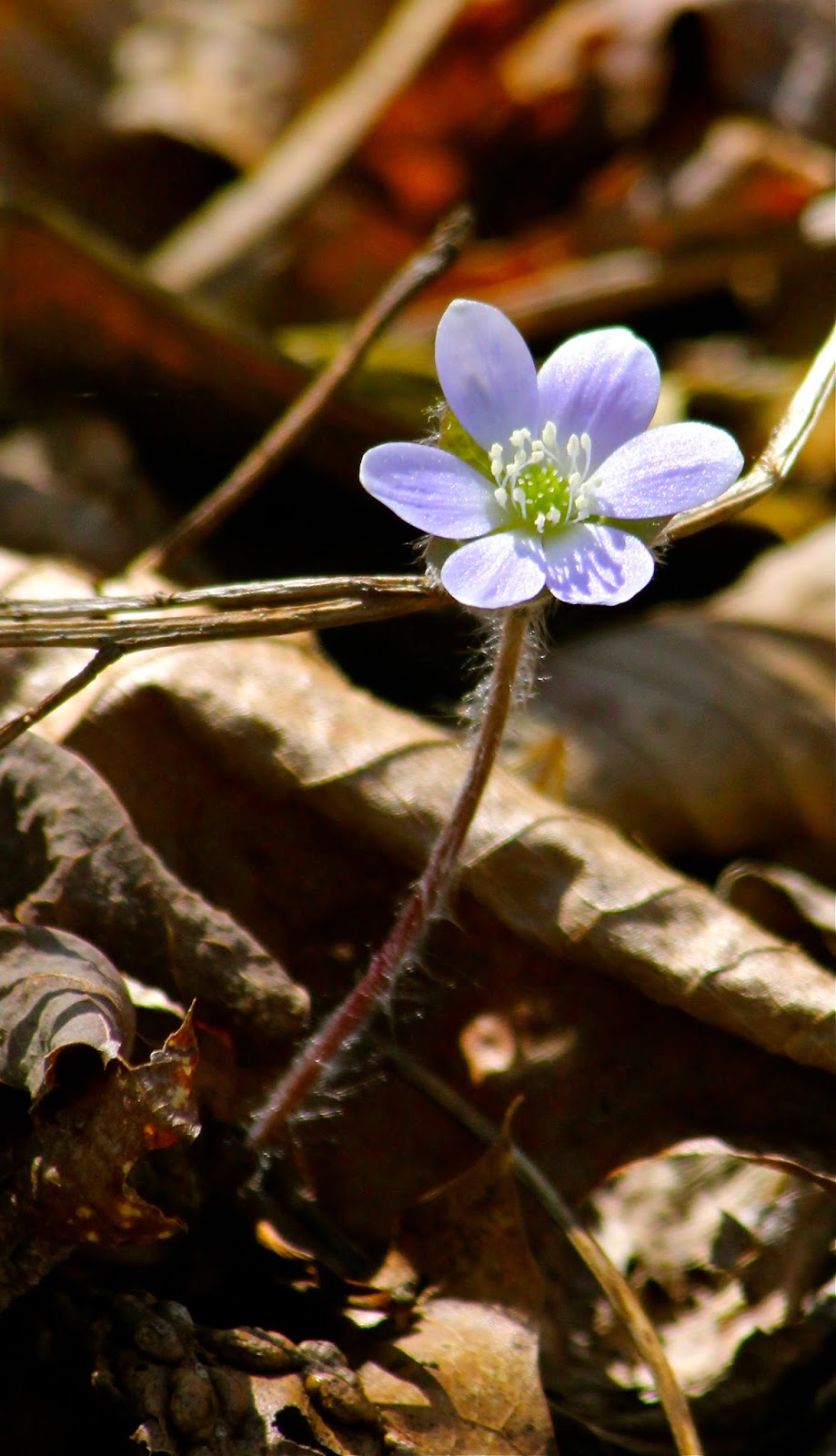
Back among the drab brown leaves, hepatica, or liverwort, lent its lovely lavender to the chorus of delicate spring color, rising on a distinctively hairy stalk from the nutrient-rich soil of the lakeside forest.


More anemones beckoned brightly from just around the bend, as our steps brought us ever closer to the headwaters of the lake.


And there we were greeted by the perfect white flowers of the bloodroot and a perplexing arrangement of petals -
some sporting nine, others eleven, still others with eight and some more than a dozen; 

a nice number-y mystery for unraveling tonight with field guide in hand.


Back overhead, bold pink buds contrasted starkly with the infinite blue, as our ubiquitous redbud trees began their stunning April show here along the margin of the piedmont and coastal plain of North Carolina.


 Eyes transitioned rapidly from the players on the stage at our feet,


and back to those above...


almost missing the true identity of this branch's leaf-like accoutrement in our determination not to trample the loveliness of the earthbound blossoms below.


Fortunately for us, the walkers in the wood, 


a brief upward glance chanced to spy the "leaf" with wings outspread, 
minute scales of orange and white reflecting the sun's rays to our eyes 
like tiny panels of stained glass,


 otherwise this natural beauty would have passed us by like a leaf on the wind.

And while we were thus distracted from the spring wildflower show, 
a mammalian companion smiled a mid-meal greeting from its sunny perch in the oaks. 


With the day well on, and a busy calendar calling, the walkers reluctantly turned toward home, 
startling an emerald-crowned wanderer from its gentle cruising across the crystal clear surface of the lake in the woods.


Henry David Thoreau, one of America's favorite naturalists, once noted, 

"An early morning walk is a blessing for the whole day."

We couldn't agree more...


Tuesday, March 31, 2015

Messenger from the Treetops... Yellow-throated Warbler

Yesterday, Julie and I enjoyed a quick hike around San-Lee Park while the boys played a little tennis across town. Even at our brisk pace, the wooded trails were chilly, so when we completed our loop, we paused to enjoy the sun on a bench by the falls. We'd barely settled on our benches when this strikingly clad character appeared at the water's edge.


Www.allaboutbirds.org, 
an outstanding educational website maintained by the Cornell University Lab of Ornithology, has this to say about our little friend... 

"...the Yellow-throated Warbler is a bird of tall trees. It nests and forages high in the canopy of swamp and pine forests."

There were plenty of magnificent pines along the ridge above the dam, so we couldn't help wondering what had enticed this tiny little bird of the tall trees down to the level of we earthbound mortals. 


 Was it the cloud of small flying insects swarming near mid-stream?


Was it the cool, clear waters of the stream, hurrying briskly away from the falls?


Or maybe it was the warm, sunlit meadow, bordered by bushes dense with just-budding branches? 


Perhaps they were all conspirators,
the babbling brook and the sunlit meadow and the bushes and the bugs, 
in luring the lovely forest dweller down. 


Whatever the reason, we were more than delighted to share our space by the stream,


as the excitable fellow flitted from branch to bridge to signpost to stone at the water's edge and back, 

before making the rounds again...


and again!

And when at last

he settled briefly in the shrub's sunny uppermost branches, 

cocking his head and setting his sights again on his faraway home in the canopy,


the mystery of this rare and wonderful encounter

with the lovely little warbler remained;

a simple gift of beauty and wonder, 

and a gentle reminder from above, 

perhaps,

that the forest and the meadow and the stream are both warbler's home and ours...


Friday, March 27, 2015

Flying Fisher

Cousin Danny spent some time communing with the ospreys this week, 
and he was kind enough to freeze a few frames for his friends at Hoot Owl Karma. 


Raptor royalty, 
effortless flyer,
gliding majestically above the rushing waters, 
oblivious to the raucous mob of gulls so boorishly wheeling and reeling and diving 
and ceaselessly calling their coarse hellos.


Omniscient osprey, 
head on a swivel, 
ever vigilant, 


perceiving the most fleeting flash of scale or fin; 
wings gathered, frozen in flight,
defying gravity,

and then...


the dive!


Another thrilling finish;
one in a never-ending series of exhilarating encounters 
awaiting those with the will and the courage to take the plunge into the wild outside... 

Thanks for sharing, Danny!

Tuesday, March 24, 2015

Pecans in the Wild

From its perch in a birch, eastern gray squirrel savors a succulent snack


a meaty pecan taken from its private reserve next door,
the fruit of a pair of massive pecan trees, 


lovingly planted sometime in the middle of the last century by the residents of a cozy urban cottage 
long since demolished in favor of another fast food joint;
property now of the urban wildlife league.


Tame or wild, 
natural or planted,
one thing is certain...

Nature doesn't end at the city limits.


Sunday, March 22, 2015

Flying Pigs and Nesting Nuthatches

The advent of spring brings with it a plethora of opportunities for Hoot Owl Karma, and we couldn't be more excited! Today we spent a while investigating some intriguing avian activity at Papa Jim and Grandma Charlene's house.

The scrubby old oak tree in front of their house succumbed to a variety of natural causes a few years back, but my dad insisted on retaining a sizable hunk of the stump for more than just old time's sake. 

In the warm summer months, it serves as a sturdy plant stand, supporting a large pot in the center and four additional hanging baskets around the sides. In the winter, it serves equally well as a landing pad for the flying pig and a varied assortment of bird feeders, providing all manner of feathered friends the opportunity to dine in the company of the blue-backed porker.


This past fall and winter, however, a pair of birds became rather fond of the stump itself, traversing its surface from top to bottom, with a particular interest in the curious formation of mushrooms on its southern flank. 


In his daily observations, my dad wondered if they were searching for insects, or perhaps eating the dried mushrooms.
Eventually, it became apparent that their interest in the stump was more than culinary. 

Slowly but surely, peck by peck and speck by speck, the industrious pair was carving a tiny custom-made nesting cavity from the old, dry flesh of the oak.


Upon our arrival this weekend, the brown-headed nuthatches were busily foraging among the bark and cones on the stately long-leaf pine which stands sentinel at the corner of the front porch.


Although they loom rather large in the zoom of our lens, these beautiful birds are quite small relative to other common backyard birds, topping out at around four inches, about the size of the tiny Carolina chickadee.


Clearly still in the nest-building stage, this handsome pair made trip after trip to and from the pine next door, bringing small pieces of bark, straw and pine seed wings with which to line the nest cavity.


The brown-headed nuthatch was a relatively common bird of my childhood in the Sandhills, and its range is confined to the pine woods of the Southeastern US like those found in our Sandhills region. Its numbers have been in steady decline since the mid-1960's along with the decline of its traditional pine savannah habitat.


Its cousin, the white-breasted nuthatch (pictured below), shares both physical similarities and similar habits, but is notably larger, lacks the brown cap, and is more commonly associated with deciduous forests. As a result, it is much more widely distributed and relatively common throughout North America.


Both the male and female brown-headed nuthatches are actively engaged in nest-building on this sunny afternoon,


and although the general physical appearance of male and female are identical,


these two individuals can be distinguished by differences in the size and shape of the white patch on the back of their heads. As to which is the male and which the female, however, we'll leave that question for the true experts!


Perhaps the most intriguing aspect of this nest-building enterprise is the siting of the cavity. As we approached the stump with our camera, having already been told where to look, it took nearly half a minute for our eyes and brains to apprehend the opening, so perfectly was it situated on the craggy bark in the shadows of a multitude of shelf fungi. 


And even as the birds peer from the opening, their brown caps and white throats blend perfectly with the brown fungi and sun-dappled dead gray bark, rendering them virtually invisible to all but the keenest eyes.


We snap a few more shots and prepare to head for home, awed and inspired once more by nature's ingenuity,


and grateful for family and friends who share our enthusiasm for the natural wonders that await just outside the door.

Spring is here, so why not open the door, step over the threshold, and join us in exploring the wonderful surprises it brings!