Sunday, December 23, 2012

...My True Love Gave to Me...a Starling in a Pear Tree!

The Callery pear (perhaps you know it as a Bradford pear) came to the US as a gift from Asia early in the last century, and after commercial cultivars were introduced by the USDA in the early 1960's, it was quickly adopted all over America as the perfect landscape tree. Fast growing, nicely shaped, lovely white blossoms in early spring, masses of green leaves in summer and spectacular fall color;  there was almost no concern about its invasive nature since the cultivars did not produce viable seeds.


You met the European starling (a gift from Europe) in an earlier post. It loves the fruit of the Bradford pear, and the pear produces fruit in incredible abundance. Unfortunately, over time, the various cultivars of the Callery pear have become so commonly planted they've managed to cross-pollinate and bear fruit with viable seeds. The root stock used for grafting various cultivars is often from a different seed-bearing genotype as well. When the roots then produce flower-bearing shoots, they can fertilize the blossoms of the grafted cultivar, yielding fruit with fertile seeds.


When the non-native starling feasts on the thousands of frost-softened fruit of the non-native Callery pear, the now-viable seeds are often deposited on fertile ground, creating thickets of pears which out-compete and stifle many native plants. Starlings flock to these fruit-filled thickets, ...


and the "gifts" just keep on giving.

Thursday, December 20, 2012

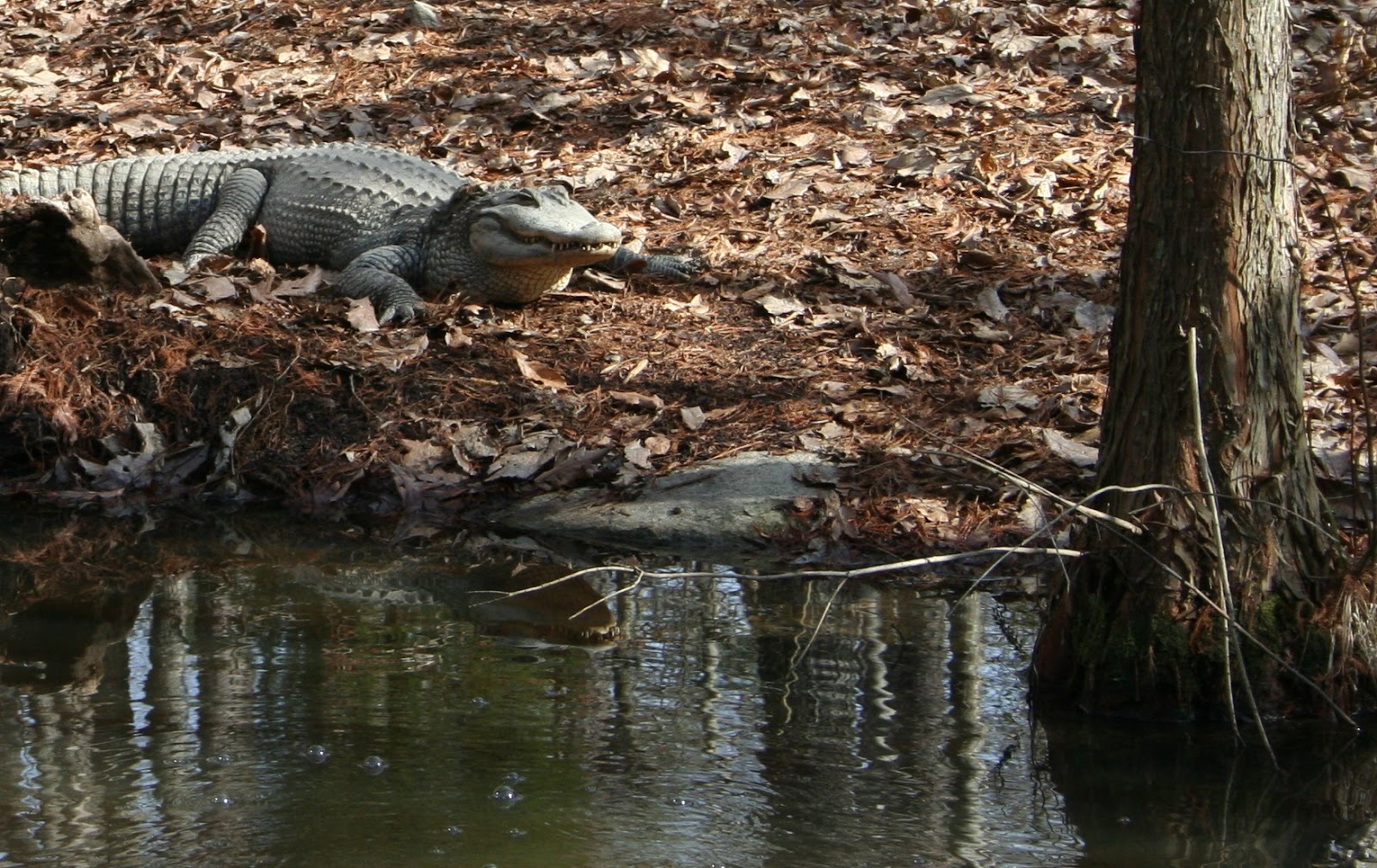
El Lagarto, Gimme some skin!

El Lagarto. Allagarter.  Alligator. 

The Lizard. 

  That's one heck of a lizard...


Knowing smile replete with dozens of impressive ivories, "el lagarto" basks motionless in the early winter sunshine of piedmont North Carolina. Largest of North American reptiles, an alligator this size is a true apex predator with little to fear other than humans with a hankering for accessories fashioned from lizard leather. Hard to imagine this critter losing its skin in a fair fight.

Hunted to near extinction in many areas by the 1960's, federal laws and effective conservation efforts have restored healthy alligator populations in much of their historic range. The Cypress Swamp habitat at the NC Zoological Park allows visitors an opportunity to observe and appreciate these awesome creatures up close.


Looking quite comfortable in its own skin, el lagarto is arguably more like a bird than a lizard in several important ways, including its four-chambered heart.   El pajaro, anyone? El ave, perhaps?

Tuesday, December 18, 2012

Song of Spring

Little bird, little bird, sing your song,
That tune you learned just last spring.

Warmth and life and joy it brings...

Sing, little bird, sing your song.


Little bird, little bird, why so mum?

Winter's here; the flowers, they are gone.

Our hearts, they crave just one more song

Of Hope...  Of Love...


Of Spring...

Sunday, December 16, 2012

Web of Life

Fall's first "hard" frost is history, but here in the Carolinas, winter has yet to gain full sway. Thunder rocked the night just ended, and the atmospheric clash of titans yielded much-needed moisture here below.


The frost has claimed our intrepid orb-weaver, but her trap lingers on, entangling dozens of  dripping fugitives from the tumult on high. Life-giving water, poised among the fruit-filled branches.


On the very eve of winter's deep slumber, nature hints at what's to come. Winter shall have her turn, but spring awaits...


Water. Seeds. 
Beautiful. Delicate. 
Vital strands in life's tenacious web.


Saturday, December 8, 2012

Going Green; Cold-blooded Chameleon

With the advent of winter, reptiles tend to make themselves scarce, even along the relatively temperate 35th parallel. This clever Carolina anole not only found enough warmth to venture forth, it even located a proper canvas for going green during a generally brown season in central Carolina.


A favorite science teacher would likely amend the title of this post with the much more appropriate and accurate ectothermic, as "cold" is such a relative term, and this amazing animal is able to regulate its body temperature by basking in the glow of a rather effective external heat source.


Whether this brief foray is solely about le soleil remains to be seen.


Perhaps the warmth will entice another ectotherm or two to brave the winter chill this afternoon.


If so, at least one little green garbed watcher awaits...

Thursday, December 6, 2012

The Moment

From time to time, just for a moment,


life and space and light coincide so vividly as to defy comprehension.


Too brilliant.                 Too real.                 Too true.         Too alive.


The mind struggles for an analog, an anchor, a prior moment of comparable clarity... validation...


Too late...


the moment is gone.


Sunday, December 2, 2012

Highland Shadows

North Carolina is a dreamland for the naturalist. From our home along the fall line adjacent to the Sandhills in the geographic center of the state, we are less than four hours from the outermost barrier islands in the Atlantic to the east, with similar distances to the 4-6000 foot elevations in the Blue Ridge and Great Smokies to the west. With ready access to such distinctly different habitat, we can experience a broad range of biodiversity with relative ease.


A group of lively shadows gathered in the late autumn sun to contemplate the splendor of the view near Grandfather Mountain from their perch atop Beacon Heights along the Blue Ridge Parkway.


The same shadows seem to be huddling for warmth on the silent windswept desert of stone - a silence broken only by the calls of an occasional crow and the merest hint of a breeze whispering amidst the lichen-clad evergreens.


The path west brought encounters with some two dozen bird species, including more than a dozen red-tailed hawks patiently scanning for prey along the fringes of the interstate corridor, a red-shouldered hawk subduing its prey in the grassy median and a barred owl roosting in a leafless wood, a bit too close to the margins for complete obscurity. Skyward focused eyes also spied evidence of other winged species, though it was a bit too nippy for the bald-faced hornets to be out and about.


At our feet was a wealth of nature as well. A tiny copse of mossy "trees" towering alongside the ferns remind us of our purpose in traveling west to locate the perfect Christmas fir.


This woolly worm, or woolly bear caterpillar seems to be enjoying the warm late-autumn sun; its broad orange band seems to be forecasting a mild winter as well.


Despite its ubiquitous blanket of cast off leaves, the forest floor still boasts a bit of colorful flora today. These galax leaves have taken on a lovely autumn hue.


And the dense masses of so-called dog hobble near the Cascades waterfall have taken on a similar cast, while still clinging to the remnants of summer's blossoms. Local lore has it that more than one bearhound has met its end after becoming helplessly entangled within reach of a cornered bear's claws.


Peering into the crystal clear waters above the falls gives the curious observer a fleeting glimpse of living color in the chilliest of climes! This lovely little brook trout coolly stalks the shivering pools in pursuit of sustenance.