Wednesday, November 26, 2014

A Perfect Tree

Bald eagle wheeled high overhead against the bright blue sky for a moment or two before soaring away at breathtaking speed. 
A good omen, we figured, as we headed west in its wake, embarking on this year's version of our annual quest for the perfect Christmas tree.


Fast forward twenty-four hours...


cold, fog and a heavy drizzle, 
and we are the only non-natives stirring along the crest of the Blue Ridge.


Young folk grazing eye the strangers' passing with mild curiosity before fading soundlessly into the mist like spirits of ancient Appalachia.


A little farther up, we dismount at a likely looking spot and pause for a portrait before inching our way forward along the ledge.


The rain intensifies as we enter a rhododendron thicket near the falls, 


and the galax at our feet glistens in the cold and damp. 


The firs and spruce dwelling here by the stream are much too tall and lanky, 
nowhere near the perfect tree, 
so we make our way farther up the mountain still...

A thousand feet higher, 
far beyond the babbling of the brook,


galax is here on the heath as well, mingling on the margins with wintergreen.


Relentless rain puddles on the barren bald; 
freeze tonight and thaw again on the morn, 
converting ancient stone to fresh new soil, 
one grain at a time.


And from this softened stone rises moss and galax and grass, 
then rhododendron and blueberry and pine. 
Pine;
stunted by the wind and ice and dearth of dirt; 
yet evergreen and shapely, 
the perfect tree?


Perhaps, we think, but who would dare to cut such trees as these?


Ancient, gnarled survivors, bowed but not broken by nature's nastiest blows.


So we linger and admire these perfect trees, 


and we pose for a picture or three, 


imagining, 
with just a hint of envy, 


the adventures they enjoy


and the sights and sounds and sensations they experience


here in their home 
on top of the world.


And then we make our way down,
leaving behind their mountaintop abode,


paths converging near the base of the slope,
a clear consensus building, 


a knowing that comes from the head and the heart. 

This year's Christmas tree, just like the last, and the one before that,  


was planted and watered and fed and groomed
on a farm in the valley,


where our one perfect tree, among thousands, 
waits patiently in the rain for our arrival.


Thursday, November 20, 2014

Color It Fall In Carolina

The old barn's still there, 
boards dry and brittle in the cold autumn sun. 

Cotton looks good this year; 
bolls plump and white to bursting.
Looks like snow.
It's not, but it sure is cold enough for it...
too darn cold for November.


Six feet of snow in Buffalo.

I'll take the cold and the cotton, and color it fall in Carolina.

Wednesday, November 12, 2014

Home Is Where the Hawk Is


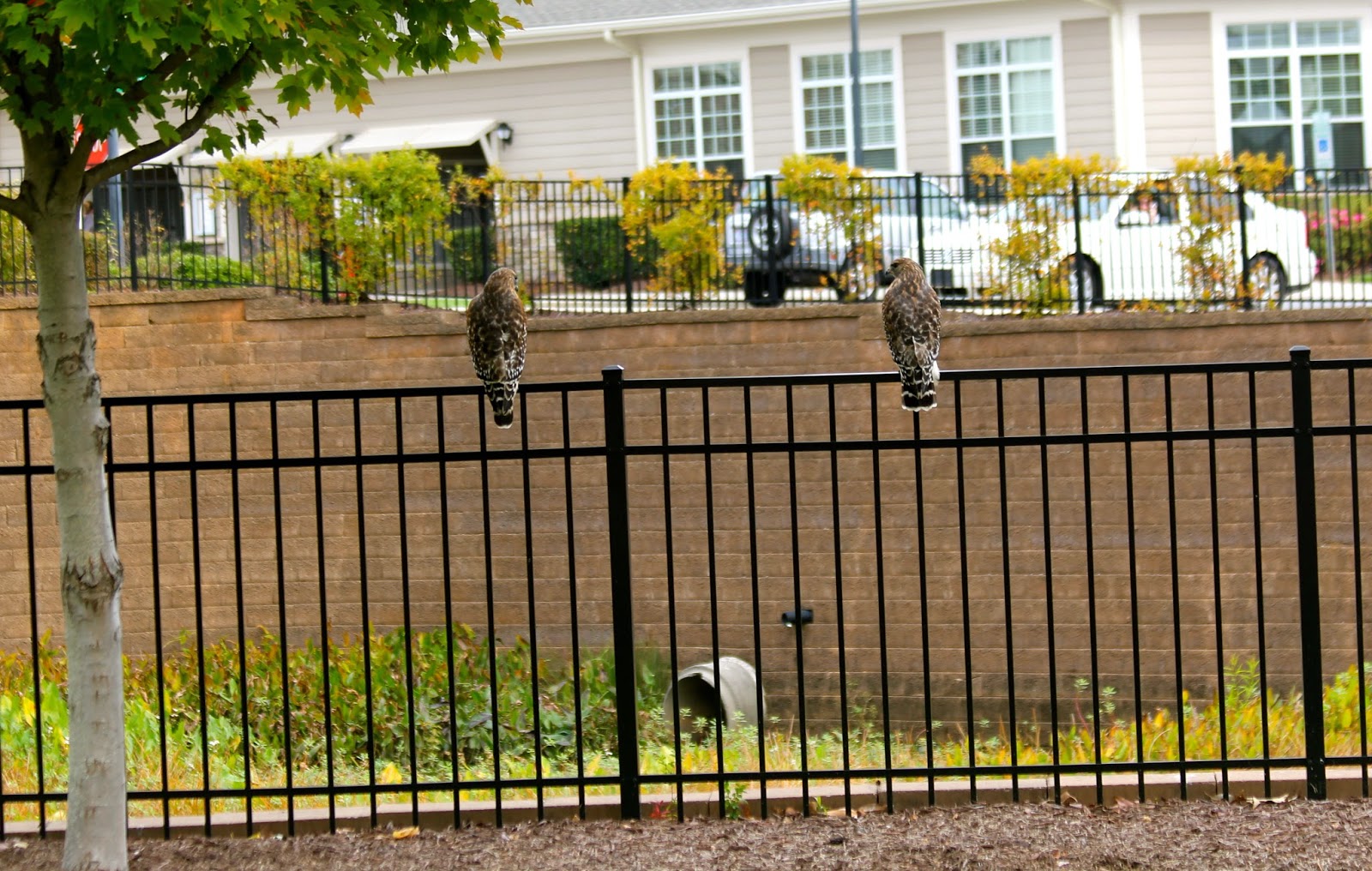
The red-shouldered hawk is a native, medium-to-large hawk of forested habitat with a definite affinity for water. It is not unusual to observe it perching near a pond or river or swamp, eyes peeled for the slightest movement that might betray the location of its next meal.


But when that perch and pond happen to be located in the midst of one of the largest commercial and residential developments in the Triangle area of North Carolina, we pause to reflect on some of our long-held notions about "the wild" and "nature" and " the natural environment." 


A quick glance at our surroundings reveals hundreds of apartments and condominiums within sight of this little pond. The development is bisected by a small but busy street, upon which several dozen cars pass during the ten minutes or so we spend observing this impressive wild creature. 
This is not the wild. 
It is not nature. 
It would be a stretch to call it a natural environment for anything other than yuppies. 


In this drastically modified environment, it is difficult not to imagine the hawk as a visitor, a wanderer, even an intruder in this carefully planned and constructed human development.
A slightly more generous view might identify the wild animal as a straggler, a solitary remnant of a once-wild place that lagged a bit too far behind the herd and found itself abandoned, left to its own devices in an altered and decidedly unnatural landscape.


But sitting here eye to eye and face to face with this magnificent and formidable predator, our view is altered. 

This animal is not lost or abandoned, neither is it visiting or intruding.

It is living.


 This pond, this space, this scattering of trees, all of this place is its home, just as it has been home to countless generations of red-shouldered hawks before. 

Face to face, and eye to eye, we wonder. 
We wonder at this marvelous creature and the wild, untamed spirit that peers back at us from those deep, dark eyes, 
and suddenly we are the visitors, the wanderers.
Face to face, and eye to eye, 
we marvel at its beauty, its intelligence, strength, and tenacity;
we marvel at its grace and patience and remarkable aplomb in the face of camera-toting intruders in its ancestral home.
We marvel and we wonder and we recognize a fellow traveler, 
a survivor, adapting to relentless changes in its environment, undaunted, 
alert and ready for the challenges that accompany this and every new day;
and we feel right at home...

Thanks to Jay Randolph for sharing his hawk pictures for this post.

Tuesday, November 11, 2014

Red-Shouldered Raptor, Noble Hunter

Noonish, mid-November. 
Cary, North Carolina, on a pristine autumn day, with light overcast and temperatures around 60 degrees. 
Red-shouldered raptor glides swift and low over the suburban street, 
joining its mate on the faux iron fence enclosing a tiny drainage pond.


They share a meaningful glance, and the flier moves on, leaving its partner to hunt alone.


A steady parade of autos cruises the busy byway, 
but this beautiful buteo is unmoved, intent on the task at hand.


Cool nights mean fewer frogs for our famished flyers, 
but the hungry, keen-eyed watcher hopes for better results in the warmth of the midday sun.


Rapt on its pondside perch, 
the red-shouldered hawk never wavers in its laser-like focus.


Orange chest and red shoulders blend seamlessly into the orange and red backdrop of the autumn maples, 


as this magnificent wild creature seeks sustenance in the very heart of suburbia.


Hunter creeps ever closer, seeking the perfect shot, 
but determined not to disturb the hawk in its life or death pursuit.


An amazing encounter, quite surreal; 
Hunter stalking hunter to the very brink of his lens's minimum focus distance,
 providing an intimate view of the distinctive red shoulders upon which the common name of Buteo lineatus is based.


At long last, the persistent shutter clicks expose our intrepid Hunter, and a piercing glance signals that it's time to part.


Adieu, mon ami, et bonne chance, noble chasseur.


Thanks to Hunter Randolph for the use of his fabulous photos.

Friday, November 7, 2014

The Little Things...

Morning dawns crisp, clear and quiet in the shadow of the lake.
Not much stirring this side of the dam, other than a few dozen vultures wheeling about in the blue, testing the thermals. 
No deer down below, nor rabbits, nor a single squirrel... only a small flock of crows and a solitary great blue working the quiet shallows just about where the field meets the wood line. 
With so little action to entertain the lens, we kneel in the dewy grass for a change of perspective...
and we begin to notice the little things.


Woolly worm devours a wild lettuce stem.
Next summer, it will assume its tiger moth guise, but for now this very hungry caterpillar has polished off a meal of tender autumn greens, and turned its attention to the stalks.
We're not woolly worm whisperers, but this one seems to be sporting a wide brown band. 
Warm winter ahead?  


While we're down here, we notice the tiny asters, situated sporadically around the perimeter of the field, squatting here and there right up to the margin of the forest itself.
And as we zoom in, still more little things come into focus.


Surprisingly, the bold black, orange and white of Ailanthus webworm moth, Atteva aurea, renders it virtually invisible, its intricate pattern of irregular spots and bands turning something into nothing right before our eyes.


As our senses attune more fully to the miniature world unfolding at our feet, more creatures emerge to attest to the allure of the dew-laden asters.


The little child inside tugs at our hand, urgently whispering "Run!", as we realize how many wasps have assembled at the asters this morning.
These are clearly the stinging kind, members of the paper wasp clan, Polistes sp.


 We recognize these two as the "red wasps" of our childhood which built large paper nests in the eaves of our house, and stung us more times than we'd like to remember. Today, however, there's no nest to defend, and the chill air seems to have slowed them a bit and reinforced the urge to nectar, so we steel our nerves and camera on...


Green and bronze blow flies abound among the blossoms as well, looking for all the world like little winged gems. Unfortunately, vivid memories of past encounters with these creatures in less savory surroundings taints our perception to this day. There's no denying, however, the critical and highly beneficial role blow fly larvae play as decomposers of organic matter.  


Yet another wasp (or is it a bee?) rudely reminds us of our entomological ignorance, prompting a muttered pledge to dust off the insect field guides upon our return home.  


Green bottle fly is camera shy. . . 


but bumblebee is oblivious to our intrusion.


Two more tiny wasps (or bees), or one of each, leave us in awe at the unexpected biodiversity in our little patch of asters. 


With dozens of different nectarers up to their snouts in aster flowers,


it's no real surprise to find a carnivore or two lurking nearby. 
Carolina mantis, Stagmomantis carolina,gives the camera a guilty nod before returning to the hunt,


while a jumping spider, Salticidae sp., eyes us octagonally.


Ctenucha virginica, a striking little moth, calls our attention back to the asters, and we marvel anew at the diverse diminutia in the dew-dampened meadow.


Another paper wasp appears, in this case not our old friend red, sporting bold yellow stripes and a healthy appetite for aster juice.


And, at long last, we spy a solitary honeybee, or else a pretty clever lookalike. 


Our hour in the asters is at an end, 
but we leave with renewed appreciation


for the little things in life.