Wednesday, April 15, 2015

One Good Tern...

For the second Sunday running, we found ourselves enjoying a stroll along the beaches of the Crystal Coast of North Carolina. 
This week found us at the opposite end of the island from where we encountered last week's lonely loon, and the shores were much less lonely here at Fort Macon State Park, playing host to a sizable gathering of seabirds. 


While we are somewhat familiar with North Carolina's sea and shorebirds, we're certainly not experts, and any trip to the coast is likely to set us thumbing through the "bird books" for a little help. On this particular afternoon, we encountered a mixed flock gathered to face the stiff coastal breeze, and we recognized its members immediately as terns, but we needed a little help to sort them all out. Turns out they were predominately royal terns in full breeding plumage, 
but a common tern or two and a pair of sandwich terns were also in attendance.


The crew made sport of holding their ground until an approaching beachcomber got too close for comfort, then taking to the air one-by-one in quite a casual and unhurried fashion.


The royal terns sported striking orange bills with black legs and a ruffled black crest, 


while the sandwich terns were a good bit smaller, with yellow-tipped black bills.

After all were airborne, they played follow the leader just above the waves 
on their way to establishing a new beachhead a bit farther along the island.


There were a fair number of gulls around as well, 
and this laughing gull seemed entirely unmoved by all the commotion,


even as the terns took up a new position a few meters down the beach.


The royal terns are large and impressive birds, second in size only to the Caspian among the terns, easily standing shoulder to shoulder with the medium-sized gulls nearby.


The contrast of bold black and white breeding plumage with bright orange bills 


gives these strikingly beautiful creatures an almost comical air, 


as their steadfast stares pierce the brisk breeze.


With their peculiarly low-slung and elongated pose, 
the clever birds almost manage to convince the photographer that the camera lens has somehow distorted the finished image.


As usual, nature has rewarded the hardy wanderers with a delightful and entirely unexpected sensory feast;


prompting us to ponder whether perhaps we can find an excuse to head this way again next weekend... 

After all, as the old saying goes, one good tern deserves another.


Thursday, April 9, 2015

Alone with a Loon at Bogue Lagoon

It's breezy and bright and just a little bit chilly as we stand on the Point at Emerald Isle and gaze to the west across Bogue Inlet at the sand and shrubs of Bear Island, home to Hammocks Beach State Park and more than a few Hoot Owl Karma encounters.

Tide's coming in, and the porpoises are playing just a few meters out along the edge of the channel. 


As we follow the shore away from the surf and toward the sound, the late afternoon glare plays tricks on our eyes;
shadows rise and fall with the waves, taking on a life of their own
as they drift among the glittering specks of sun and foam.


But just there, beyond the next little wave, appears a living shadow; 

dark head bowed t'ward the shimmering surface, eyes intent on the depths below, 


until our lone traveler vanishes as suddenly as he appeared. 

Moments pass, then more and a few more still... 
A full minute elapses, and then...

Up periscope!


Still partially submerged, cruising submarine style, 
surveying the surface with head and eyes and bill barely above water, 
the identity of our water-bound wanderer becomes apparent.


A lonely loon, perhaps pausing for a meal on the long return journey to its breeding grounds in the far north, or maybe a young bird residing here for a longer spell. 

Right on cue, it dives again, spending another minute or so below the surface,


before bursting dramatically onto the scene again, 
directly in line with the incoming rays of the slowly setting sun.


We amble along, and he swims along beside, 


keeping the sun in our eyes and giving the camera's light sensor fits...


and then, a slight curve in the shoreline, 
and with it a brief respite from the cloaking effects of the sun's brilliant rays. 


Our companion's handsome garb emerges in all its black and white brilliance, 
adorned with tiny globular prisms of glistening brine, 
a delight to both eyes and lens, 
and then...


back to the shadows again.


We sit on the sand and wonder, 
as bird and porpoises cavort in their life-filled lagoon, 
how very awkward must we appear,
high and dry and lonely upon the shore.

Monday, April 6, 2015

Big Bird Sanctuary

Cape Carteret, a cozy little coastal retreat, tucked up against Bogue Sound on the mainland just across the Atlantic Intracoastal Waterway from Emerald Isle... 

Our clan has been retreating to our own special corner of the neighborhood there for generations, just a couple of blocks over and a couple of blocks back from the old ferry landing, right at the end of Live Oak Drive. 

It's a pretty humble place, as far as vacation destinations go, with an eclectic mix of year-round residents and vacationers, and an equally eclectic assortment of dwellings, from tiny trailers to cottages or "beach houses," as we've always referred to the cottage there on Live Oak. Back in our early days there, the street wasn't even paved, and it ended rather abruptly in a greenbrier thicket filled with all manner of coastal shrubs and towering old pines. 
There are a few more "nice" houses now, and not many vacant lots left, but it is still the perfect little getaway for folks seeking a few days of peace and quiet and sanctuary from the busy-ness back home; 
sanctuary too, as long as I can remember, for the birds.


Cape Carteret advertises itself as a bird sanctuary on the signs welcoming you to town, and that it is... Hoot Owl Karma has shared our experiences with Cape Carteret's birds in the past, and our visit this weekend reassured us that the birds are doing just fine. 

We awoke on Easter morning to a glorious chorus of birdsong to rival any heavenly choir, and a leisurely stroll down to the water by the light of the just-risen sun found us in the company of brown thrashers, northern cardinals, gray catbirds, eastern bluebirds, yellow-shafted flickers, red-bellied woodpeckers, blue jays, northern mockingbirds, boat-tailed grackles, mourning doves and European starlings, just to name a few!

And as we were wrapping up a photo op with this female northern cardinal, striking a classic pose in the lower limbs of a scraggly old dogwood, we heard quite a ruckus resonating from the rotting trunk beyond...


as this big old pileated woodpecker furiously attacked the dying wood!


We've had a few run-ins with this magnificent woodpecker before, but none quite this up-close and personal, so we paused for a few moments to admire his work.


Unfortunately, these are not moving pictures, nor did we record any sound, so you'll have to take our word for what a dynamic scene unfolded before us - wood chips and dust filled the air as this largest of North American woodpeckers hammered the old dogwood with its sturdy and resilient bill.


Leaning back ridiculously, perilously, awkwardly far, balanced only by its lengthy tail feathers, then rock(et)ing forward with all its might, triggering another shower of chips, before pausing to inspect its progress.


This particular excavation was a mere meter above the ground, so we're pretty sure this big fellow was prospecting for food, not excavating a nest cavity.


In either case, we witnessed the awesome power and efficiency of one of Cape Carteret's big birds, and what a thrilling and wonderful privilege it was.


Hearts still racing with excitement, we headed back home for a bite of breakfast, only to hear this remarkable singer broadcasting from the absolute uppermost branches of a still-leafless oak in the back yard of the beach house. As we sidled over to snap a shot of handsome brown thrasher serenading the entire neighborhood, a subtle movement caught our eye from the direction of the neighbor's house, just beyond the trunk of the oak.


We took a knee in the shadow of the heat pump just before a most amazing creature strode into full view...


another of Cape Carteret's big (heck, this one was downright huge) birds, a gorgeous wild turkey hen.


The morning sun glinted off coppery-bronze body armor, making an outright liar of the field guide author who described the female wild turkey's plumage as "brown".


Motionless but for the twitching of our shutter finger, we watched for a full breathless minute as this magnificent bird foraged it's way across the narrow yard between our beach house and the neighbor's, 


never quite stopping, but pausing in its steady progress long enough to pluck a bit of the fresh green grass along the way.


As the wandering wildfowl came fully abreast of our position, it turned its head our way


and held our gaze for a full two seconds, before lengthening its stride and quickening its pace toward the small patch of trees just beyond the basketball goal at the end of Live Oak Drive.


What an awesome Easter morn, communing with our fellow creatures in the peaceful quiet and serenity of the neighborhood we share, 


the big birds' sanctuary, and ours.

Friday, April 3, 2015

A Walk in the Woods...


A couple of years ago, right around this time of year, we went for a wonderful walk in the woods among the wildlife and early spring wildflowers along Island Creek in eastern North Carolina, where we encountered hundreds of emerging bloodroot blossoms.


 And although the first of April this year found us hanging out a little closer to home, we ventured over to our own San-Lee Park in hopes that the similar habitat along the upper reaches of the lake might harbor some of the same lovely blooms. 
We were not disappointed!


 Spring had arrived in the woods and on the waters, as these basking sliders took advantage of the same blue skies and sunshine we walkers found so invigorating.


Not only was the bloodroot beginning to blossom, 
but the rue anemone erupted from the drab browns and grays of the forest floor in an eye-catching display of delicate pink and brilliant ivory hues.


The birds wanted in on the action as well, with this red-bellied woodpecker drawing our eyes skyward to discern the source of its drumming.


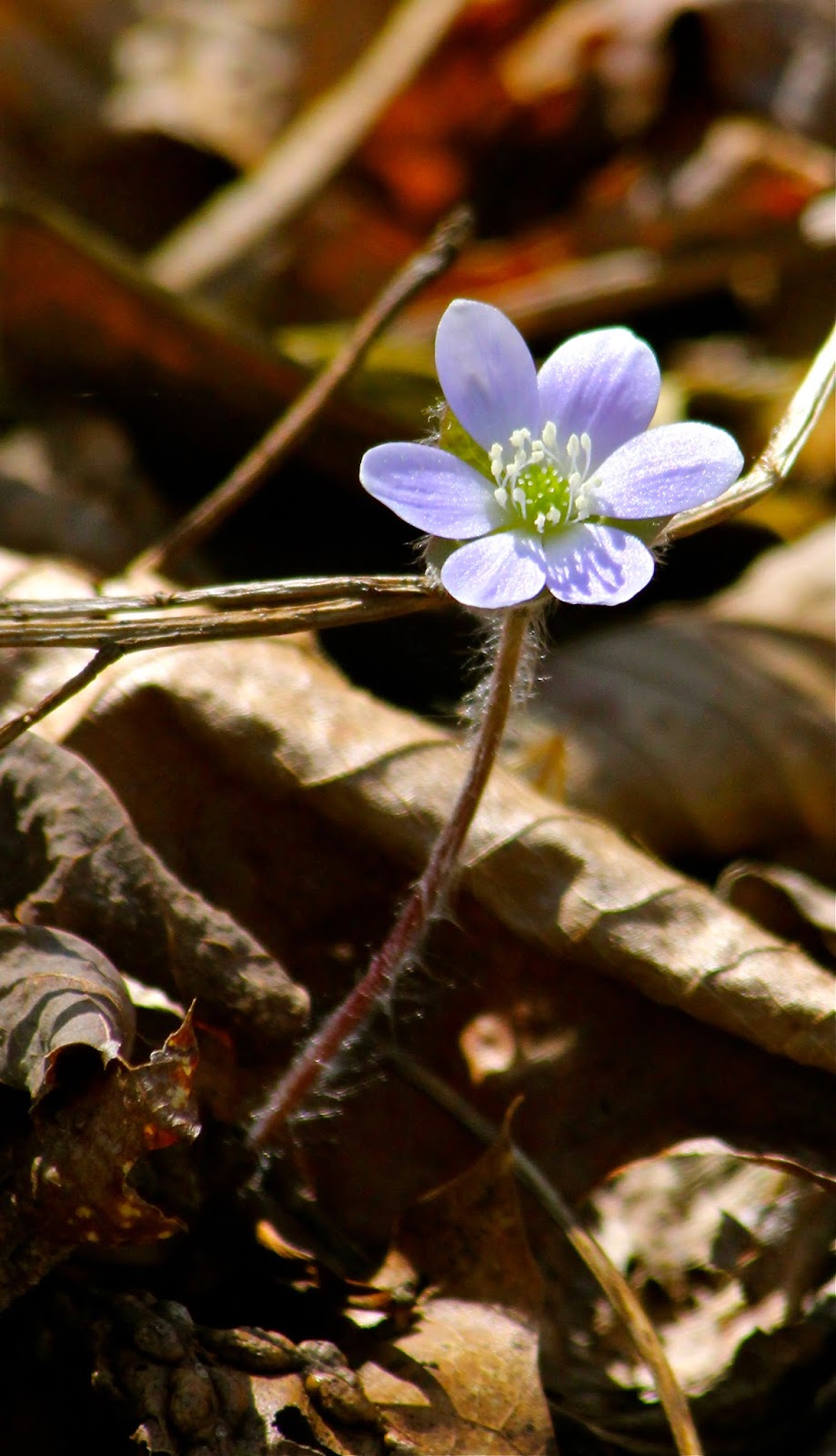
Back among the drab brown leaves, hepatica, or liverwort, lent its lovely lavender to the chorus of delicate spring color, rising on a distinctively hairy stalk from the nutrient-rich soil of the lakeside forest.


More anemones beckoned brightly from just around the bend, as our steps brought us ever closer to the headwaters of the lake.


And there we were greeted by the perfect white flowers of the bloodroot and a perplexing arrangement of petals -
some sporting nine, others eleven, still others with eight and some more than a dozen; 

a nice number-y mystery for unraveling tonight with field guide in hand.


Back overhead, bold pink buds contrasted starkly with the infinite blue, as our ubiquitous redbud trees began their stunning April show here along the margin of the piedmont and coastal plain of North Carolina.


 Eyes transitioned rapidly from the players on the stage at our feet,


and back to those above...


almost missing the true identity of this branch's leaf-like accoutrement in our determination not to trample the loveliness of the earthbound blossoms below.


Fortunately for us, the walkers in the wood, 


a brief upward glance chanced to spy the "leaf" with wings outspread, 
minute scales of orange and white reflecting the sun's rays to our eyes 
like tiny panels of stained glass,


 otherwise this natural beauty would have passed us by like a leaf on the wind.

And while we were thus distracted from the spring wildflower show, 
a mammalian companion smiled a mid-meal greeting from its sunny perch in the oaks. 


With the day well on, and a busy calendar calling, the walkers reluctantly turned toward home, 
startling an emerald-crowned wanderer from its gentle cruising across the crystal clear surface of the lake in the woods.


Henry David Thoreau, one of America's favorite naturalists, once noted, 

"An early morning walk is a blessing for the whole day."

We couldn't agree more...