Showing posts with label herpetology. Show all posts

Monday, March 11, 2013

River Walk - Rue Anemone and More

When time springs forward each year in the heart of Carolina, the lost hour of sleep is immediately replaced by an "extra" hour of daylight. Hoot Owl Karma chose to spend that extra hour today in search of another early blooming wildflower, the rue anemone. Upon entering the woods in a likely spot beside a meandering woodland stream, the quester was greeted by a strident chorus of frogs arrayed along the margins of the deeper pools. While hundreds of voices were involved in the performance, a single diminutive northern cricket frog was the only visual evidence of amphibians to be found.


Just a few yards up the hillside, this brown-skinned basker seemed determined to make the most of its extra hour of sunlight as well. Carolina anole may soon take on its cloak of green, but for today, brown was definitely the color of choice.


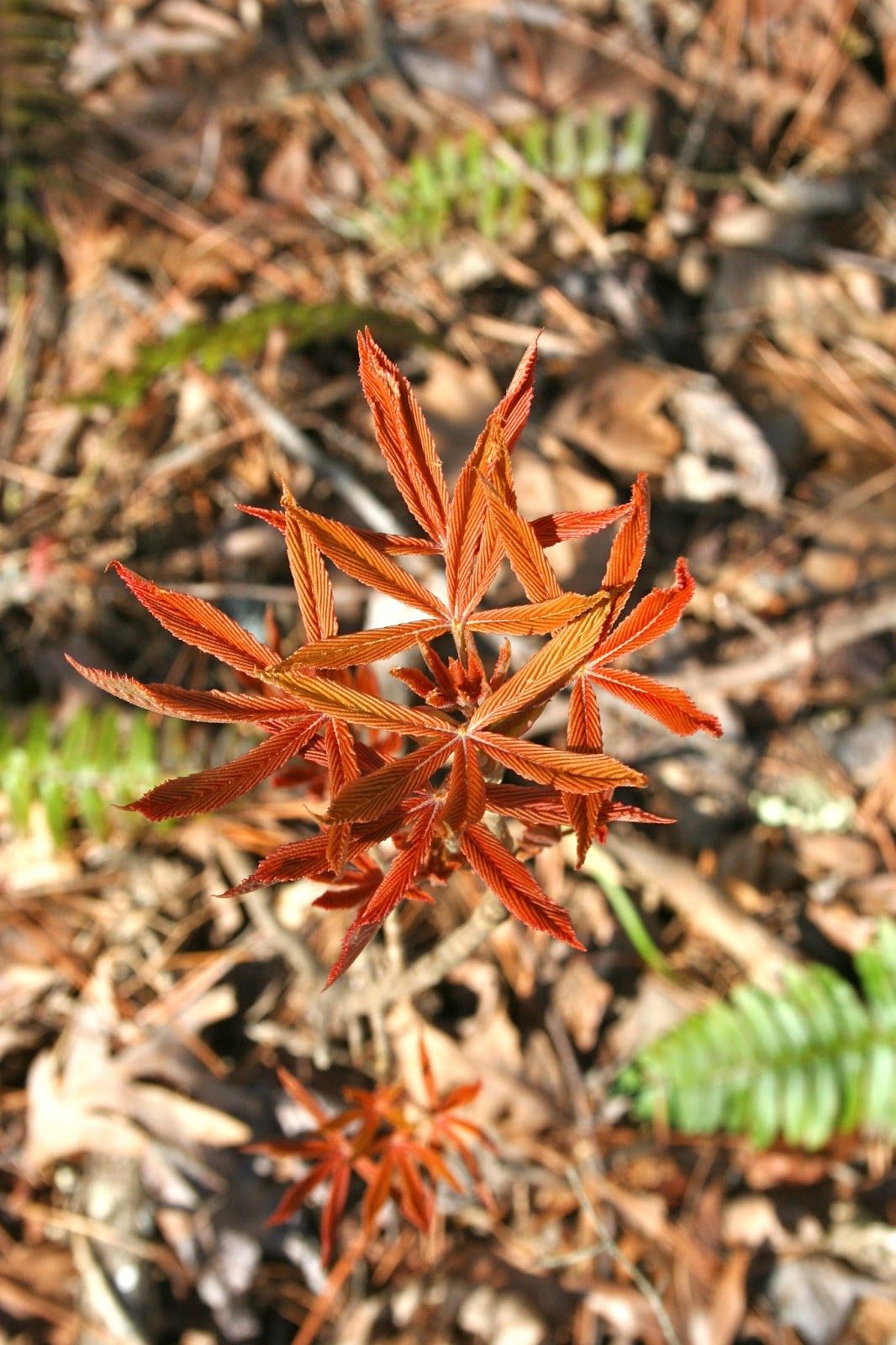
While scanning the bottomland for the telltale blossom of the anemone, the wanderer observed other signs of spring. Dozens of these striking stems dotted the floodplain along the stream, teasing the observer with just a hint of their true identity.  


A bit farther along, their intrigue abruptly ended when this complex matrix of 5 pronged leaves gracefully unfurled. The red buckeye would be well represented in these parts this year! 

Suddenly, and at last, the rue anemone! Invisible for a time in the sun-dappled expanse of browns and tans and faded browns on the forest floor, but glaringly obvious once the image of the first flits across the visual cortex of the seeker, several individuals now spring into view.


Judging from the small numbers and the early stage of the blossoms, we caught these lithe beauties just after their initial emergence. Whether blessing, good luck or karma, we're grateful for the cosmic juxtaposition which allowed us to complete our trifecta of hepatica, anemone and spring beauty with rather little effort on this gorgeous afternoon.


A parting look, then out of the woods for a while. We'll have to settle for the domesticated spring blossoms for a few days until we can slip away for another walk on the wild side.

Friday, March 8, 2013

Snapshots of a Snapper with the Griffin Scholars

Yesterday's nature excursion with the young scholars of Griffin Academy was blessed by brilliant sunshine, not too brisk temperatures and tremendously enthusiastic adventurers. Armed with nets and plastic containers, our intrepid nature explorers captured an impressive array of dragonfly nymphs, tadpoles, minnows and snails, along with gobs of slimy green hair-like pond scum or filamentous algae, most likely colonies of spirogyra.
Our bold young Griffins also showed off their photography skills when confronted with a rather large and apparently rather dead common snapping turtle. 


Chelydra serpentina is North Carolina's largest native turtle, and this fifteen-pounder had apparently succumbed to the cold of winter or perhaps old age.


Inappropriate attire notwithstanding, Mr. Jimmy gingerly retrieved the carcass from the water's edge so that the students could have a closer look, as they documented the procedure with a handy-dandy iPhone camera.


Imagine their suprise when the decidedly not-dead reptile suffiently shook off its late-winter torpor to demonstrate for everyone the origins of its common name by attempting to carve up the toe of Mr. Jimmy's entirely inappropriate footwear!


With the "snapper" re-oriented away from all the nearby toes and ankles, everyone took a moment to appreciate the awesomeness of this fully alive and operational predator from the depths.


A truly awesome creature, extremely well-adapted to its aquatic environment. Its impressive tail was nearly as long as its carapace, and more than one child compared it to a dinosaur's. The head was massive, with really cool-looking eyes, and mouth exceedingly well-equipped for grabbing and holding slippery prey. The shell sported a healthy growth of algae, which would obviously serve its host well in the business of camouflage on the bottom of the pond.

 
Our budding young scientists thoroughly exhausted Mr. Jimmy's knowledge of these extraordinary creatures, and left him with plenty of questions to be researched later.


Presumably much relieved to be finished with its fifteen minutes of fame, the subject of our brief but enthusiastic examination hunkered back down into the mucky bottom from whence it was so unceremoniously extracted, most likely resuming the not quite finished business of its long winter's nap. 


Farewell, old turtle!

Thursday, February 28, 2013

On the Road Again...Ambling Amphibians


A quick trip to Grandma and Grandpa's Tuesday night over rain-drenched roadways was accompanied by the late winter soundtrack of the spring peeper. As the temps dipped into the lower fifties (F), their song slowed a bit, but Hunter did spot this little guy on the move around 8 p.m.

Looks like the spring peepers aren't the only amphibians in the chorus tonight. This toad was also on the move, most likely hoping to bump into another like-minded bufo on this late winter's eve.


NC is home to three large toad species, and this particular stretch of road in the Sandhills is practically on the line between the ranges of the southern and American toad populations. Most likely this is a southern toad, and we wish it success on its quest for a mate, because Carolina's toads consume vast quantities of insects each year.


On the trip home, temps had fallen still further, and Hunter spotted very few amphibians on the move. The lone exception was this cool character, still sporting a coat of mud from its burrowing. This eastern spadefoot toad is in a different family than NC's true toads, and has much smoother skin that they.

These gifted diggers have a special spade-like projection on their hind feet for better burrowing, and they emerge on only a few rainy nights each spring to mate. As the weather warms up a bit more, we'll keep our eyes and ears open for more amphibians on the move...

Monday, September 17, 2012

Limbless Climber, Snakes in the Trees


Tiny serpent, fierce display. Juvenile black rat snake.


Rat snakes today are often encountered around structures - barns, abandoned houses, even occupied homes in rural settings. Of North Carolina's 30-40 native snakes, the black rat snake is probably one of the least-maligned; perhaps because the adults' dark, generally patternless form is not immediately associated with its venomous kin in the mind of the casual observer. 

This juvenile has not yet transitioned to its darker garb, but at it has inherited its forebears' arboreal habit.


Long before there were hen houses and rodent-filled haylofts to climb, the black rat snake was pursuing its prey (or escaping its pursuers) in the treetops.


As this youngster demonstrates, no limbs are no impediment for this reptilian, giving the term "scale a tree" a different twist. 


What goes up, must come down; an adult black rat snake demonstrates a typical limbless descent.


Whether flitting through the foliage or gliding gracefully along the ground, the black rat snake must daily make the most of dramatic habitat changes throughout its historic range if it is to reach the age of sexual maturity and do its part to perpetuate the species.


Monday, September 10, 2012

Fashion Faux Pas - Never Wear Green After Labor Day!

For the fashion conscious in the rural American South, white is traditionally a summer color. Virtually every budding young Belle south of the Mason Dixon line has endured the admonition, "We never wear white after Labor Day!"

Labor Day has come and gone here in Carolina, and headlines throughout the region this morning celebrated the early arrival of fall, with highs predicted in the upper seventies (fahrenheit), and a glorious week of mild and sunny weather ahead.


But who needs a weather forecast? With the first cool nights of September, the sweet gum leaves tell the tale. Summer nears its end. And, as summer goes, so goes the green garb of the deciduous trees and the lush green herbs of the ditch bank and field. And so goes the advantage for the wearers of the green. Did someone say, "Never wear green after Labor Day?"


As with all traditions, there are the few, the bold, the non-conformists. Those who push the boundaries, who ignore the whispers and stares and proudly flaunt their individuality. In human society, these folk are often the avant-garde, the tradition changers, celebrated in retrospect for their courage and vision.


Nature will be the judge of our emerald friend's daring fall fashion decision. Here's hoping it's not too harsh...

Saturday, September 1, 2012

Eastern Kingsnake - Not Always Easy Being King

Eastern kingsnake living up to its name as it attempts to ingurgitate a young northern water snake. The eastern kingsnake consumes a variety of prey in addition to other snakes, and is not harmed by the venom of North Carolina's pit vipers, including copperheads and rattlesnakes.


Royal Family - Kingsnakes of North Carolina


Kingsnakes, rulers of Colubridae and victors in Viperidae as well.

Family Colubridae "Snake"- encompassing the vast majority of the world's snakes, almost entirely non-venomous.

Genus Lampropeltis - "Shiny Shield"- referencing the glossy dorsal scales of these beautiful animals.

Merciless in their pursuit of sustenance, these "kings" dispatch their fellow colubrids (and the occasional venomous viper) at a rate surpassing King Henry VIII's disposal of wives. Lizards also litter the larder, and insects will do just fine too!


The Scarlet Letter; S is for Scarlet Kingsnake


Master Mimic; "Red touch yellow, kill a fellow; red touch black, friend of Jack." 

The scarlet kingsnake is a classic example of Batesian mimicry, in which a vulnerable prey animal evolves to closely resemble a venomous or toxic relative, in this case the eastern coral snake; prompting parents and scoutmasters throughout the southeast to teach their children the mnemonic "Friend of Jack" rhyme.


Friday, August 10, 2012

Where Have All the Pine Snakes Gone...


Didn't find nary an egg this morning, that chicken snake's back!
...hung down from the roof of the coop and touched the ground, and that thing's way over six feet tall!
...stretched clear across the driveway, couldn't even see where he ended in the weeds on the other side...

Where's he gone... let me get my gun!


Where has he gone?


Where has she gone?


Where have all the pine snakes gone?
Long time passing...

Where have all the pine snakes gone?
Long time ago...

Where, oh where, have they all gone...?
Northern Pine Snake           Harnett County, NC
When will we ever learn?

When will we ever learn?

http://naturalsciences.org/