Showing posts with label nc herps. Show all posts

Monday, April 22, 2013

Blind Eyes and Redbellies

A quick hike before Hunter's soccer match in Chapel Hill yields an interesting encounter with a languidly lounging reptilian. Distracted by the abundant painted buckeye blossoms, walker one and walker two nearly tread on the unmoving and unmoved sunbather, until Jay casually asks if we saw the snake.


In spite of its relatively large girth and nearly three foot length, this snake's dull brown dorsum and utter stillness would have allowed it to go completely unnoticed by the hike's blind-eyed leaders. But thanks to Jay's young and curious eyes, we recognized our friend the redbelly water snake, lying in the leaves just a few feet from the trailside stream.


A closer look reveals the reason for its languor, and the unusually dull dorsum...the snake appears to be molting, or shedding its skin. Turns out the hikers aren't the only blind-eyed creatures on the trail today! As you can see from the picture above, the specialized "eye cap" or ocular scale which covers the eye of snakes, has loosened and is beginning to peel away, along with the rest of the skin on its head, rendering this individual temporarily blind. We quietly left this fellow to finish shucking his worn-out dermis, and later located a few pictures of his Lee county kin with a bit fresher skin.


The redbelly water snake is North Carolina's version of the plainbelly water snake found throughout the southern U.S. In other regions, the belly is a pale yellow or almost white, but consistently lacks any markings, hence plainbelly.


This one was encountered in late April last year in Lee County's San-Lee Park, and it took a moment to calmly check us out before returning to the waters of the nearby lake. These snakes are not aggressive, but if handled or harassed, they will strike and/or bite repeatedly and release an extremely foul-smelling musk to discourage predators.


After testing the air with its tongue and apparently finding our presence distasteful, this impressive specimen casually moved on to a better spot at the water's edge.


Sunday, April 21, 2013

Amphibian Awareness - Sensitive Skin

Yesterday's spadefoot toad inspired some interesting reactions from folks, one of whom wondered at the rather unhealthy looking water in which the toads were carousing. This comment raised an important point regarding amphibian physiology and their highly specialized skin. So here's a few more thoughts and photos from Hoot Owl Karma's rainy night rambling.


Amphibians have adapted to life on the margins of aquatic and terrestrial habitats, and because individuals will likely spend part of their life cycle in each of these very different environments, they have a remarkable skin. Both water and oxygen diffuse freely through the skin, allowing the animal to "breath," or effectively carry on respiration in either environment. In order to facilitate this remarkable process, amphibians must maintain sufficiently moist skin; mucous glands in the skin help by secreting a protective mucous coating (hence the frog's "slimy" reputation).


Sitting roughly six inches tall, this bullfrog dwarfed the other amphibians that were out enjoying the storm.


Their wonderfully adapted skin, combined with access to clean, moist environments, allow amphibians to lead a healthy "double life" in a semi-aquatic environment. Because of their dependence on water for survival, ecologists and environmental scientists believe amphibians are critical "indicator species" with regards to water quality.

Unfortunately, as highlighted in a National Geographic article from 2010 posted at their website,
" Nearly 1 in 3 of the 5,743 described amphibian species are in decline, according to survey results released last month. At least nine species have disappeared since 1980."

Research to better understand the causes of this global phenomenon are underway around the world, but in the meantime, there is a clear imperative to do what we can to protect and improve the quality of the earth's water for all creatures, great and small.


Meanwhile, back in North Carolina, when Hoot Owl Karma returned home, this pickerel frog waited to welcome us in the driveway.

If you are interested in learning more about these amazing creatures and their place in our ecosystem globally and right here at home in North Carolina, you might want to check out the Amphibian Awareness Day at the NC Zoo next weekend (April 27th). 


Saturday, April 20, 2013

April Showers Bring May Tadpoles...

Back in late February, Hunter encountered an Eastern Spadefoot Toad crossing a rural Sandhills byway. It appeared to have just emerged from a muddy winter hideaway, probably drawn forth a bit prematurely by the unseasonably warm, wet weather. On that occasion, we neither saw nor heard any more of its kin in the immediate vicinity. 
Fast forward to last night. Mid-April, 3 hours of steady evening showers and thunderstorms. Temperatures around 68 degrees (F). The same stretch of rural blacktop. 
There, on the warm, wet pavement, no less than three eastern spadefoot toads in a ten foot expanse. Slow the car, listen. From the dark ditches comes a discordant din of nasal "wanks" as dozens of spadefoots congregate in the warm rainwater.

 As we discovered in February, the spadefoot derives its name from specially adapted pads on its hind feet which allow it to burrow rapidly into the sandy soil of its preferred lowland habitat. Tonight however, the lonely subterranean dens have been abandoned for the communal breeding pond provided by the evening's heavy downpour.


Driven by instincts eons in the making, and guided by the calls of the males, the sandhills spadefoots gather to perpetuate their species. Dozens are here already, with others arriving by the moment.


The warm water is cloudy with pollen and adrift with debris brought down by the gusty winds of the storm, but the toads aren't complaining. Spadefoots are thought to skip some breeding years entirely, if the April rains don't come timely and in sufficient quantities, so tonight's event is not to be missed, lest no similar opportunity present itself this year. 


Because of the ephemeral nature of the breeding pools, the eggs and tadpoles will mature rapidly, and the next generation should be afoot in less than a month.


 The utter darkness, the chaos of the storm and the incessant calls of the males, repeated urgently  with intervals of a couple of seconds or so, add layers to the experience which are simply impossible to convey with photographs alone. Here's a tiny snippet (the boys promise to teach me to use the iPhone properly before next time)! 


The male pictured below seems intent upon unseating his rival, already grappling with a female in the lower right of the picture, with the sheer volume of his calls.


His white throat balloons dramatically as he channels nature's call and strives for the opportunity to perpetuate his genetic line.


All around the pool, the same scene plays out, as more players enter the stage from every direction.


Sheltered in our homes, glued to the screen, we hang on the words of the forecasters, hopeful that the storm will quickly pass and spare us. Outside, in the pouring rain and driving winds, amidst the swirling waters of the debris-laden ditches, the eastern spadefoots embrace the moment.


And life goes on...

Sunday, April 14, 2013

Mysterious Morchella - Stalking the Wild Morel

Growing up wild in North Carolina, some of the most memorable moments I've spent in the outdoors have come while engaged in gastronomic pursuits. Nature offers the knowledgeable an abundance of natural treats, not least among them (despite their diminutive size) a number of edible fungi. My favorite is the wild morel, and early April is its season here in the south.


Wild morels adorn the tables of the world's finest restaurants, and they can command a hefty price. Online gourmet food sites might offer dried wild morels for $150-$200.00 per pound. Fortunately for us, a pound or two of fresh morels are easily obtained each spring from the Carolina forest at no charge. 


When the pines release their pollen in earnest, the fiddleheads of the fern unfurl, and the mayapples spread their verdant parasols, it's time to head for the bottomland hardwood forests in pursuit of this elusive springtime delicacy.  


Mycophagists from the midwestern U.S. post pictures of forest clearings and green meadows with dozens of large, plump yellow or black morels awaiting the lucky forager. Communities such as Boyne City, Michigan host annual Morel Festivals, and award trophies to grinning mushroom hunters whose buckets are brimming with hundreds of these tasty morsels.


Our experience here in the heart of Carolina has been a bit different. A very successful foray might yield dozens, not hundreds, of morels, found growing singly or perhaps in small clusters of three to five; and averaging 1-2 inches in height, not 3-6 inches as in some other regions. But we're not complaining!


A typical morel-bearing site in our area is a mature bottomland forest, split by small streams and boasting significant numbers of tulip poplar trees, mixed perhaps with American beech, hickory, ash, sweet gum and sycamore trees. Our experience suggests that the southeastern species of morel we collect, Morchella virginiana, has a mycorrhyzal relationship with the tulip tree, and recently published scientific studies seem to concur.


Once a promising site is located, the real challenge begins. Morels emerge when the forest floor is still largely brown with fallen leaves, and both their wrinkled, pitted contours and brown or tan color render them almost invisible amongst the beech leaves and sweet gum balls.


While morels are a delicious treat when properly cooked and prepared, the quest itself is every bit as rewarding as the hoped-for meal. The gift of a few hours in the Carolina outdoors in spring is priceless. 


A recent foray was conducted to the soundtrack of a pair of foraging pileated woodpeckers which seemed to follow us throughout the entirety of our excursion, and another led us to an encounter with this eastern box turtle, just emerged from a long winter's nap.


In fact, morels and old turtles are but a few of the recently emerged one might meet on an early April mushroom foray in the wilds of Caroline...  


eastern cottontails in miniature, 


many-legged millipedes,


and marbled salamanders,


to name a few.

Happy Hunting!


Monday, March 11, 2013

River Walk - Rue Anemone and More

When time springs forward each year in the heart of Carolina, the lost hour of sleep is immediately replaced by an "extra" hour of daylight. Hoot Owl Karma chose to spend that extra hour today in search of another early blooming wildflower, the rue anemone. Upon entering the woods in a likely spot beside a meandering woodland stream, the quester was greeted by a strident chorus of frogs arrayed along the margins of the deeper pools. While hundreds of voices were involved in the performance, a single diminutive northern cricket frog was the only visual evidence of amphibians to be found.


Just a few yards up the hillside, this brown-skinned basker seemed determined to make the most of its extra hour of sunlight as well. Carolina anole may soon take on its cloak of green, but for today, brown was definitely the color of choice.


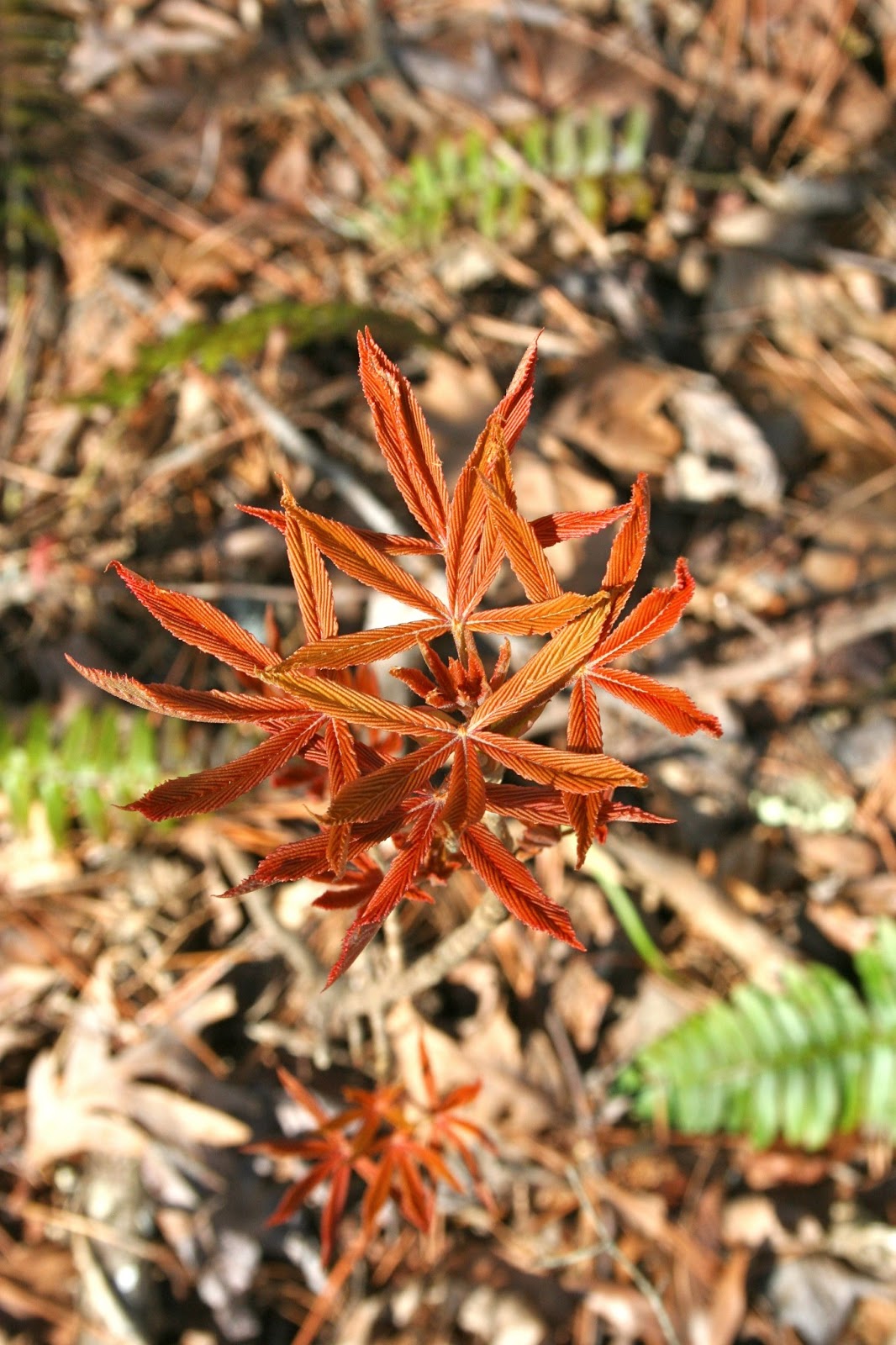
While scanning the bottomland for the telltale blossom of the anemone, the wanderer observed other signs of spring. Dozens of these striking stems dotted the floodplain along the stream, teasing the observer with just a hint of their true identity.  


A bit farther along, their intrigue abruptly ended when this complex matrix of 5 pronged leaves gracefully unfurled. The red buckeye would be well represented in these parts this year! 


Suddenly, and at last, the rue anemone! Invisible for a time in the sun-dappled expanse of browns and tans and faded browns on the forest floor, but glaringly obvious once the image of the first flits across the visual cortex of the seeker, several individuals now spring into view.


Judging from the small numbers and the early stage of the blossoms, we caught these lithe beauties just after their initial emergence. Whether blessing, good luck or karma, we're grateful for the cosmic juxtaposition which allowed us to complete our trifecta of hepatica, anemone and spring beauty with rather little effort on this gorgeous afternoon.


A parting look, then out of the woods for a while. We'll have to settle for the domesticated spring blossoms for a few days until we can slip away for another walk on the wild side.

Thursday, February 28, 2013

On the Road Again...Ambling Amphibians


A quick trip to Grandma and Grandpa's Tuesday night over rain-drenched roadways was accompanied by the late winter soundtrack of the spring peeper. As the temps dipped into the lower fifties (F), their song slowed a bit, but Hunter did spot this little guy on the move around 8 p.m.

Looks like the spring peepers aren't the only amphibians in the chorus tonight. This toad was also on the move, most likely hoping to bump into another like-minded bufo on this late winter's eve.


NC is home to three large toad species, and this particular stretch of road in the Sandhills is practically on the line between the ranges of the southern and American toad populations. Most likely this is a southern toad, and we wish it success on its quest for a mate, because Carolina's toads consume vast quantities of insects each year.


On the trip home, temps had fallen still further, and Hunter spotted very few amphibians on the move. The lone exception was this cool character, still sporting a coat of mud from its burrowing. This eastern spadefoot toad is in a different family than NC's true toads, and has much smoother skin that they.

These gifted diggers have a special spade-like projection on their hind feet for better burrowing, and they emerge on only a few rainy nights each spring to mate. As the weather warms up a bit more, we'll keep our eyes and ears open for more amphibians on the move...

Saturday, September 1, 2012

Royal Family - Kingsnakes of North Carolina


Kingsnakes, rulers of Colubridae and victors in Viperidae as well.

Family Colubridae "Snake"- encompassing the vast majority of the world's snakes, almost entirely non-venomous.

Genus Lampropeltis - "Shiny Shield"- referencing the glossy dorsal scales of these beautiful animals.

Merciless in their pursuit of sustenance, these "kings" dispatch their fellow colubrids (and the occasional venomous viper) at a rate surpassing King Henry VIII's disposal of wives. Lizards also litter the larder, and insects will do just fine too!


The Scarlet Letter; S is for Scarlet Kingsnake


Master Mimic; "Red touch yellow, kill a fellow; red touch black, friend of Jack." 

The scarlet kingsnake is a classic example of Batesian mimicry, in which a vulnerable prey animal evolves to closely resemble a venomous or toxic relative, in this case the eastern coral snake; prompting parents and scoutmasters throughout the southeast to teach their children the mnemonic "Friend of Jack" rhyme.