Showing posts with label natural history. Show all posts

Sunday, April 14, 2013

Mysterious Morchella - Stalking the Wild Morel

Growing up wild in North Carolina, some of the most memorable moments I've spent in the outdoors have come while engaged in gastronomic pursuits. Nature offers the knowledgeable an abundance of natural treats, not least among them (despite their diminutive size) a number of edible fungi. My favorite is the wild morel, and early April is its season here in the south.


Wild morels adorn the tables of the world's finest restaurants, and they can command a hefty price. Online gourmet food sites might offer dried wild morels for $150-$200.00 per pound. Fortunately for us, a pound or two of fresh morels are easily obtained each spring from the Carolina forest at no charge. 


When the pines release their pollen in earnest, the fiddleheads of the fern unfurl, and the mayapples spread their verdant parasols, it's time to head for the bottomland hardwood forests in pursuit of this elusive springtime delicacy.  


Mycophagists from the midwestern U.S. post pictures of forest clearings and green meadows with dozens of large, plump yellow or black morels awaiting the lucky forager. Communities such as Boyne City, Michigan host annual Morel Festivals, and award trophies to grinning mushroom hunters whose buckets are brimming with hundreds of these tasty morsels.


Our experience here in the heart of Carolina has been a bit different. A very successful foray might yield dozens, not hundreds, of morels, found growing singly or perhaps in small clusters of three to five; and averaging 1-2 inches in height, not 3-6 inches as in some other regions. But we're not complaining!


A typical morel-bearing site in our area is a mature bottomland forest, split by small streams and boasting significant numbers of tulip poplar trees, mixed perhaps with American beech, hickory, ash, sweet gum and sycamore trees. Our experience suggests that the southeastern species of morel we collect, Morchella virginiana, has a mycorrhyzal relationship with the tulip tree, and recently published scientific studies seem to concur.


Once a promising site is located, the real challenge begins. Morels emerge when the forest floor is still largely brown with fallen leaves, and both their wrinkled, pitted contours and brown or tan color render them almost invisible amongst the beech leaves and sweet gum balls.


While morels are a delicious treat when properly cooked and prepared, the quest itself is every bit as rewarding as the hoped-for meal. The gift of a few hours in the Carolina outdoors in spring is priceless. 


A recent foray was conducted to the soundtrack of a pair of foraging pileated woodpeckers which seemed to follow us throughout the entirety of our excursion, and another led us to an encounter with this eastern box turtle, just emerged from a long winter's nap.


In fact, morels and old turtles are but a few of the recently emerged one might meet on an early April mushroom foray in the wilds of Caroline...  


eastern cottontails in miniature, 


many-legged millipedes,


and marbled salamanders,


to name a few.

Happy Hunting!


Monday, April 8, 2013

Reflections at the Fort Macon Jetty...

The Jetty.  
Emblem of man's eternal struggle against the forces of nature. 
Impertinent sea! Incorrigible sand! 
Can't you see we've built a fortress here?! How dare you move it?! 

Come along now, waves, let's see what you do with ten thousand tons of granite!


Amorphous island shaped by the seas for countless centuries welcomes the unyielding granite boulders, rough edges already worn smooth in a few brief decades by the relentless caress of millions of tons of water and salt and sand, by the barnacles, and mussels and oysters and still more sand. 
Tides surge forward, then relent, hour after hour, day after day, as they've moved for millennia by the moon's sleight of hand. 
Wind and rain play no small part, as the ancient mountain stones imperceptibly multiply, pulverized in super slow motion, newly liberated particles collaborating with their predecessors to grind away at the mother stone.


Bird reflects, and bird knows.
Peering from the surface of the sand-lined tidal pool, nestled in the bosom of the boulder, the bird knows the sand, and the tides, and the waves, and the wind and the rain. The bird knows the barnacles, and the mussels, and the oysters, and the boulders, and all that sand. 
With feet, and legs and bill and eyes and eyelids and oil glands and feathers shaped by the sand, and the tides, and the winds, and the rain, and nourished by the barnacles, and the mussels, and the oysters and the other food hidden in the boulders and all that sand, the bird reflects, and the bird knows. 


Time is its teacher. Unhurried, unharried, eternal and unending. 


Man races in for the briefest of moments. He sees and smiles and snaps his photos and leaves. 


The bird preens, and reflects, unhurried and unharried. Time passes, and the bird knows.

Will man ever know?


 Time will tell...

Saturday, September 8, 2012

Let It Be...A Moment in Nature

Late summer evening in the heart of Carolina. The pond is alive. Great egret works the shallows and green heron lurks in the willows just as the last rays of the setting sun yield to the shadows. Suddenly, radiant red sparks erupt from the bank like an unexploded pyrotechnic spontaneously igniting. But it's alive, this crimson geyser of reflected sunlight. This glorious denizen of the riparian zone bears the name cardinal flower.


It is a given name, just like the moniker borne by the belted kingfisher regaling us with its raucous rattle, and the   mottled gray Carolina mantis hunting nearby.

Nature. Alive. Boundless. Eternal. Named.

Observed, identified, catalogued, added to a list. Convenient.


Surrounded by the diverse but orderly array of previously discovered and named members of our ecological community, I wonder... Is something lost when a name is assigned, a label affixed, a species identified?


Is the immensity diminished as order is established? Does the awe and wonder recede as well?

Look! Hiding there! What is it ?! A spider. A tiny, furry predator lurking amidst the radiant waves of red. What species? Let's look it up on the internet!

Stop.

Deep breath.

It is a magnificent creature, and so are you. Creatures communing, sharing a moment or two of an indescribably vast and wonderful journey. Let it be nameless. Let it BE...

Thursday, August 9, 2012

The Watcher in the Kudzu


In the beginning, when kudzu first began its inexorable assault on the southern landscape, native arthropods jockeyed for position among the   acres and acres of huge green leaves. Lining up for a turn at the fragrant purple flowers. Seeking shelter in the cool depths of a veritable ocean of foliage.

Over time, a hierarchy was established.

At the apex, perching motionless, ever watchful,
watching and watching, and watching still...

with all eight eyes...


sporting an invisibility cloak perfectly suited for this emerald sea, the ruler of this domain,

the Green Lynx Spider.

Lynx. So named for the cat-like leap with which it so often ends its watching...

It is a fearsome predator, favoring bees and nectar-loving wasps, without regard for their pitiful stings.

The Kudzu kingdom has found its queen, an eight-legged one.

Wait... Is that a mockingbird I hear?!


Wednesday, August 8, 2012

Ghost Plant

Wandering lonely in the deep, dark wood, a traveler knelt for a moment 'midst the massive beeches when she spied nearby a tiny pair of pale and lovely ghosts.Transfixed, she pondered their cold, delicate features. Flowers, no doubt, their form declared; but no hint of green colored their existence here in the shadows. As if raised from the remains of some tragic, long-lost princess, these corpse flowers bowed their precious heads in silent vigil, oblivious to the intruder's gaze. 


Monotropa uniflora a.k.a Ghost Plant, Corpse Plant, Indian Pipes, Ice Plant


Cousin to the the azaleas, rhododendrons and blueberries in the Heath family, this little woodland mystery is a flowering plant, not a fungus, though its total lack of chlorophyll leads many to that mistaken conclusion.


Parasitic on the mycelium of russula mushrooms that are themselves in a mycorrhyzal relationship with the American Beech trees and Loblolly Pines, these lovely little vampires draw life from the trees.

Tuesday, August 7, 2012

August Orchid


In a time before scribes, people spoke of Owl's Head or Bobwhite's Moccasin.

Roots were dug, and tea was made.

Healers danced and sang their songs.

Snakebites cured and headaches gone.


Now it is written...

Platanthara ciliaris,  Yellow-fringed orchid.


Fifty golden dervishes, frozen mid-whirl, the inflorescence beckons, welcoming its ephemeral airborne consort, the swallowtail.


Glowing beacon.


Sweet, sweet nectar.


Pollinator nourished, pollen conveyed, next August's orchids arranged...


Today, in the increasingly rare spot where sufficiently acid soils and adequate sunlight conspire with mysterious subterranean mycorrhizae to urge this flaming gem from the earth, the keen observer will join the timeless throng mesmerized by its myriad charms.


The cure, the balm, the august orchid...


Monday, August 6, 2012

Close Encounters

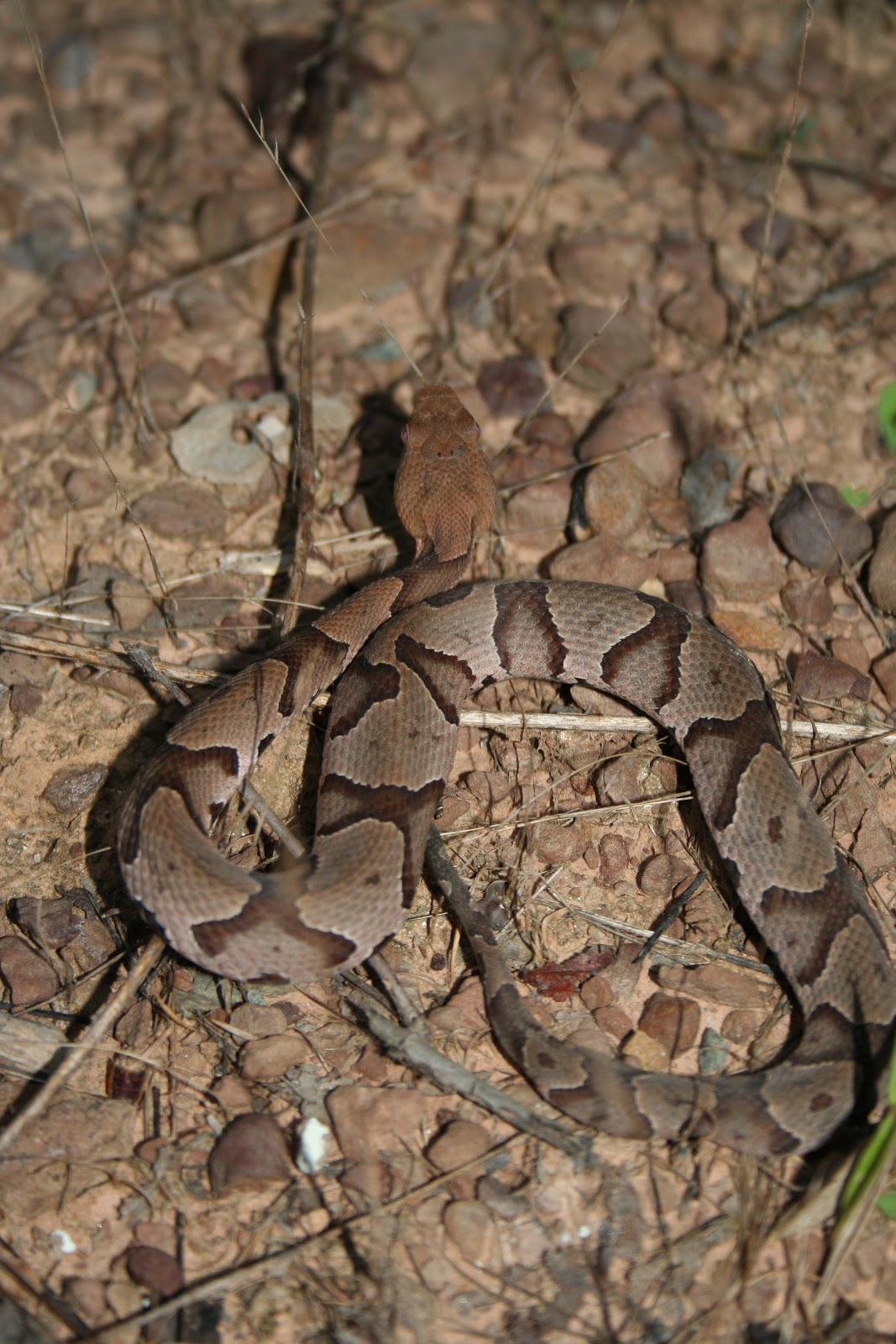
Agkistrodon contortrix...Copperhead!

Kill the beast!

Fighting instincts eons in the making and cultural constructs codified since Genesis,  a chill literally running up my spine... my soul proffers an alternative view, exchanging fear for awe, heart still racing...

Beautiful creature. 

Formidable hunter. 


Juvenile, as evidenced by its diminutive stature and greenish tail tip. Probably had its fill of grasshoppers or cicadas, just trying to keep a low profile and avoid detection by the neighbors. 


 Twenty years ago, this little corner of the universe belonged to his clan. Today, not so much.

Carefully corralled, conveyed a few miles farther out, given a few more years...perhaps.


Fare thee well?


Recommended Resources:     NC SNAKE IDENTIFICATION

Sunday, August 5, 2012

Dog-Day Cicada

Dog-Day Cicada
Sweltering mid-summer afternoon. Not a whisper of a breeze. All nature's on siesta. Profound silence.

Stop... Listen... What's that sound?

Begrudgingly, your brain acknowledges the relentless, monotonous metallic hum.  Timeless, persistent soundtrack of dog day afternoons across the South, the cicada song. Fueled by nature's incessant drive to survive, the cidada's serenade is a self-fulfilling prophecy, confirming next August's gig well in advance.


Same time, same place, same tune...

Newly emerged adult with nymphal exoskeleton


Saturday, August 4, 2012

Dog Days Delirium


My 45th passage through the dog days of summer in the Sandhills of North Carolina, and the maypop has shared them all. The still, shimmering sands bear little fruit during the sweltering days of August, but the vigilant traveler will spy the brilliant purple passionflower meandering alongside in the unlikeliest spot.


Pause for a closer look amidst the foliage and part the leaves of the neighboring plants to which the tenacious tendrils cling, and one may be rewarded with a glimpse of the prize, the thing itself, the ovoid emerald, the maypop. 

Patience. Still green. Right now it'll serve better as a green grenade for sweaty late afternoon battles with the cousins... With cooler weather, when the fruit is yellow and shriveled, the sweet, gelatinous flesh surrounding the seeds will render a treat to rival the pomegranate. Perhaps we can even convince Mom to put up a few jars of maypop jelly for the winter.