Sunday, March 3, 2013

More Winter Wildflowers - Spring Beauty and Marsh Marigold

*Karma Note... A helpful reader suggested that the "marsh marigold" pictured below was actually figwort or lesser celandine, an invasive non-native species which is often confused with marsh marigold, of all things. Duly noted, and such assistance is always welcome! (JR, 4/1/2013)
 
Winter's chilly grasp still asserts itself each evening here in the heart of Caroline, and the morning chill reminds us that Spring has not yet sprung. But a short meander off the beaten path reveals a couple of upstarts, determined to get a head start on their early spring rivals by braving the chilly air - Spring Beauty and Marsh Marigold. 


Spring beauty has many manifestations across our region, with these individuals a bit paler than many of their kin.


While these early bloomers often form impressive colonies, this tiny clump had staked its claim to a small patch of sunlight alongside a temporary stream filled by the recent heavy rains.


Not far away, at the junction with a larger creek, a pile of debris deposited in the floodplain by a larger rain event in the distant past gave shelter to a mass of bright green leaves belonging to this marsh marigold*.

These outliers were blooming even earlier than the rest of their clan; lending the otherwise lifeless marsh the green and gold hues of summer or early autumn.


This particularly bold blossom seemed determined to overshadow the discarded automobile tire inside of which she found herself contained. Faced with such a bold and valiant vanguard, can Spring herself be far behind?


Saturday, March 2, 2013

Nature's Palliative Palette - Scarlet

The northern cardinal is without doubt one of the most familiar North American songbirds. A Google search for cardinal bird yields more than 150,000,000 hits, an indicator of this bird's near-universal appeal and the wealth of readily available information related to it.

Common and familiar though it may be, whenever I encounter images of nature's brilliantly clad birds from around the world, thoughts of the northern cardinal bring me right back home. 


For, though the panoply of fantastic blues and greens and yellows adorning the inhabitants of some exotic locale can be absolutely breath-taking, the scarlet clad crooner perched by the feeder out back  can hold its own with them all in my eyes. 


Poets and philosophers have long attested to nature's palliative powers; soothing the cares of the day, easing life's burdens in some small way. For all their skill with words and eloquent elocutions, the wordsmiths might do well to pause in silent contemplation when confronted by nature colored thus...


Peace, my friend.

Thursday, February 28, 2013

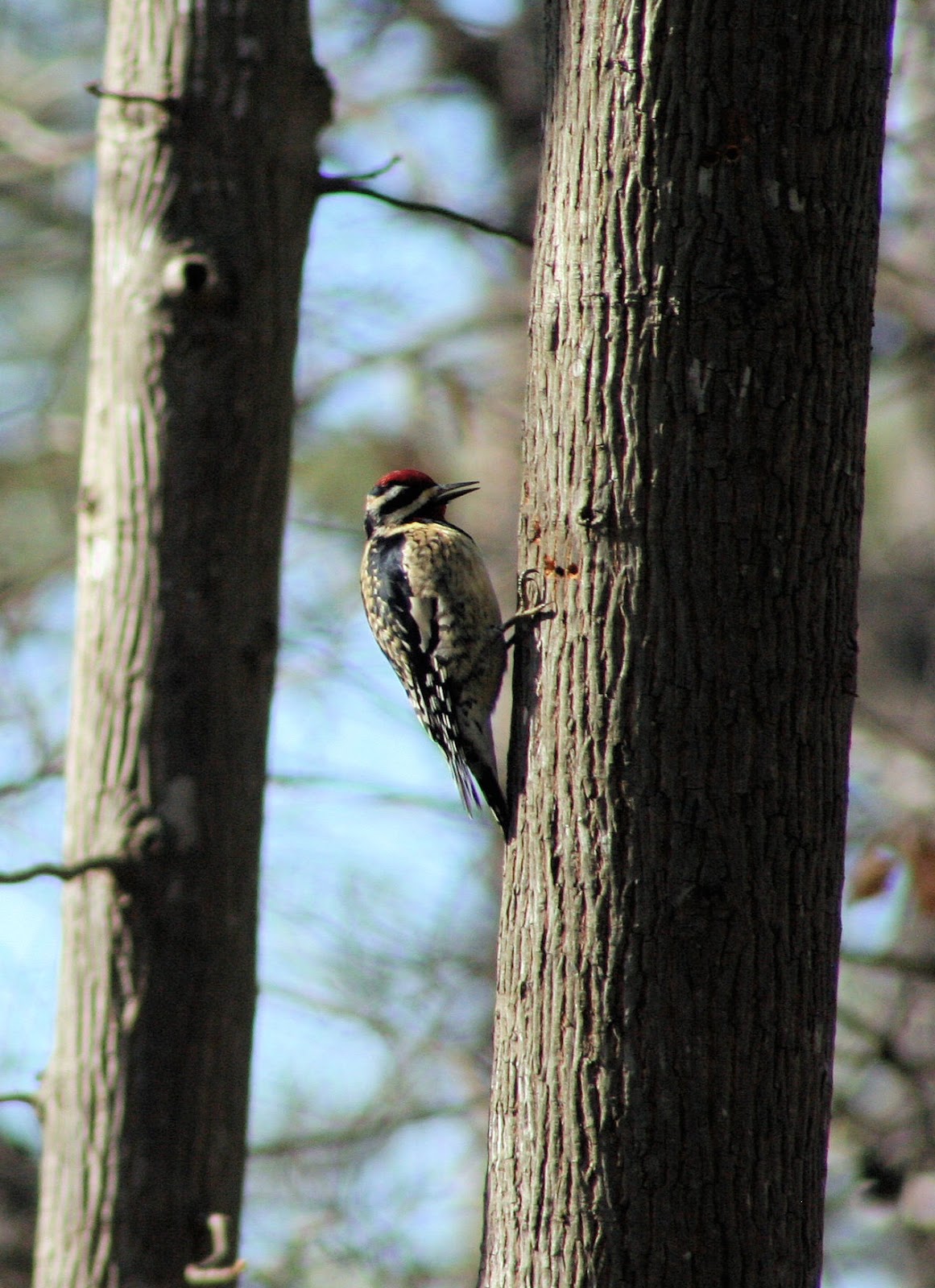
Myth of the Yellow Bellied Sapsucker

For many in my generation, Yosemite Sam immortalized the Yellow Bellied Sapsucker as the epitome of cowardice and generalized despicableness with his half-crazed rants calling out Bugs Bunny in the old Looney Tunes cartoons.

Departing the park yesterday, we spotted this handsome male adjacent to the parking area, flitting from one young hickory to another, apparently checking its sap holes for food.

It never came near enough (or remained stationary long enough) for a great shot, but it was such a striking individual, I thought I'd share the few images I did capture.

In this last photo, the sap holes are clearly visible; they were made previously, and this fellow seemed to be "making his rounds" to check for sap, or perhaps insects trapped in the sap which had flowed since his last visit.

I saw nothing in my brief encounter to reinforce the low-down, cowardly impression of the sapsucker perpetuated by old Yosemite Sam. To the contrary, I was most impressed by the beauty, grace and ingenuity of this fine creature. Guess you can't believe everything you hear on TV...

On the Road Again...Ambling Amphibians


A quick trip to Grandma and Grandpa's Tuesday night over rain-drenched roadways was accompanied by the late winter soundtrack of the spring peeper. As the temps dipped into the lower fifties (F), their song slowed a bit, but Hunter did spot this little guy on the move around 8 p.m.

Looks like the spring peepers aren't the only amphibians in the chorus tonight. This toad was also on the move, most likely hoping to bump into another like-minded bufo on this late winter's eve.


NC is home to three large toad species, and this particular stretch of road in the Sandhills is practically on the line between the ranges of the southern and American toad populations. Most likely this is a southern toad, and we wish it success on its quest for a mate, because Carolina's toads consume vast quantities of insects each year.


On the trip home, temps had fallen still further, and Hunter spotted very few amphibians on the move. The lone exception was this cool character, still sporting a coat of mud from its burrowing. This eastern spadefoot toad is in a different family than NC's true toads, and has much smoother skin that they.

These gifted diggers have a special spade-like projection on their hind feet for better burrowing, and they emerge on only a few rainy nights each spring to mate. As the weather warms up a bit more, we'll keep our eyes and ears open for more amphibians on the move...

More Early Bloomers - Hepatica (Liverwort)

As winter wanes and the weather warms, trout lilies aren't the only wildflowers worth watching. The distinctive three-lobed leaves of liverwort offer a clue to the keen observer that the early-blooming hepatica is here.

Sure enough, lovely lavendar-blue blossoms peer forth a few feet from last year's latent leaves. 


Nearby, another pair emerges. Hairy stalks and three-lobed leaf confirms the call, Hepatica americana,  round-lobed hepatica or liverwort. 


Not nearly as numerous as yesterday's trout lilies, but all the more appealing for their scarcity, these tiny towers arise from the monotony of the forest floor across a quarter acre or so of dry, rocky hillside.


Living amethysts scattered carelessly among the cast off leaves of summers past.


What meaning, this revelation? This tiny explosion of color from a bed of brown? 


Beauty in the eye of the beholder; Joy at witnessing another of life's little mysteries...


Oh, look! Those are a different color! I wonder...

Monday, February 25, 2013

Seer of the Swamp and Forest

Seer; sage; surveyor of the deep, dark wood.
Keeper of the ancient forest;
Sharp, keen eyes of the swamp.
The dark of the moon is broad daylight
For the midnight watcher's perfect sight.

What's become of the forest;
What of the deep, dark wood?

Scant clues to the mystery
In the seer's deep, dark eyes.


Barred Owl. San-Lee Park.

Winter Wildflowers - Trout Lily


Hoot Owl Karma recently happened upon a reference to North Carolina's native early bloomers; winter wildflowers which portend the advent of spring. First on the list were skunk cabbage, trout lily and hepatica. Since other commitments precluded the three hour drive to skunk cabbage territory, the Hoot Owl clan settled for a brief visit to nearby San-Lee Park, a "hidden gem" for nature lovers in the Central Carolina area. 

We had barely entered the heavily forested "Big Woods," when the sun-dappled forest floor came alive! Where just weeks before there was nothing but leaf litter, pinestraw and sweet gum balls, the slope above the small stream was completely overtaken by a sprawling encampment of trout lilies.
Although many locals refer to these abundant spring wildflowers as dogtooth violets, they are actually lilies.  The piscene portion of their name apparently refers to the resemblance of the mottled pattern of the lily leaves to the mottled dorsum of the brook trout, which shares neighboring habitat with the trout lily in many locales.

Sun-drenched lily prominently displaying the trout-like mottling of its leaves...
A closer look at the strongly recurved petals/sepals of the lily blossom; the petals are yellow above and below, while the sepals are yellow above and burnished bronze or chestnut brown below. 

Although one of central Carolina's most common early wildflowers, the trout lily is uncommonly beautiful, and well worth the effort of a trip to the woods from now until mid-March in your neighborhood. They are highly photogenic as well, the shot below was taken with a phone; just take care not to trample the little beauties if you approach for a closer look.

Special thanks to Hunter Randolph for his contributions to the photography for this post; he may soon be buying his own camera so as not to compete with Dad for shutter time...
This little cluster of lilies is getting pretty cozy with the wild ginger, we'll have to come back when it warms up a bit for a glimpse of their blossoms. Stay tuned...