Thursday, April 4, 2013

More Wild Moments - Croatan Cottonmouth

Meandering beneath the canopy of the majestic longleaf pines, we spied a glimmer of sunlight reflecting on  the surface of water.  A small pond awaited, surrounded on all sides by the pine forest, sporting a few dozen waterlilies, and surrounded by the remnants of last years reeds. We moved closer, careful of getting our feet wet, hoping for a glimpse of some spring wildflowers or perhaps a deer slipping down for a late afternoon sip. Moving a bit too quickly, with our eyes on the pond margins, we almost literally stumbled across this curled up critter chilling in the reeds!

Agkistrodon piscivorous, the cottonmouth, one of North Carolina's five venomous snakes from the family Viperidae.


Shaken by the suddenness of the encounter, for the merest moment, we thought we were in the presence of one of its cousins, but the absence of a rattle quickly put that notion to rest. Large girth, roughly triangular head, vertical pupil and its distinctive markings, including a dark band through the eye, all helped with the positive identification of this impressive animal as a venomous water moccasin, and not one of its non-venomous water snake lookalikes.


 We observed quietly from a safe distance until this laid back lounger became bored with us and decided to move on in the direction of the pond.


With darkness on its way, we took this as our cue to be moving on as well; just in case the warm afternoon sun had lured forth any other baskers that might still be moving about in the twilight. After all, there is such as thing as too much of a good thing, even with Hoot Owl Karma... 

Wednesday, April 3, 2013

Red-Cockaded Woodpecker...A Rare Encounter

Fresh from our exciting encounter with the red-headed woodpeckers, Hoot Owl Karma headed into the wild for a late afternoon hike in the Croatan National Forest. Croatan offers a glimpse into North Carolina's wilderness past with its relatively large stands of mature longleaf pines. This unique ecosystem is home to the endangered Red-cockaded Woodpecker which builds its nests exclusively in living longleaf pine trees.


 This stand of pines had recently experienced a wildfire, giving us a firsthand look at the role fire plays in maintaining the health of the longleaf pine ecosystem. Periodic fires keep the understory open and eliminate competition from less fire-resistant trees which might otherwise out-compete the young pines.


Within moments of entering the forest, we spy evidence of the rare woodpecker. A nest cavity, excavated from a large living longleaf, oozing copious amounts of sticky sap. 


The fresh flowing sap helps protect the nest from predators such as the black rat snake which might raid the nest for its eggs or nestlings.


We spot several other nest cavities, but see no sign of their makers until the sun has nearly dropped behind the tree-line. Suddenly Julie and Hunter call to us in hushed tones. They've spotted a bird pecking at the bark high up on the sunny side of a young longleaf. Could it be...?


Yes, without a doubt, our first encounter with the rare red-cockaded woodpecker! This one sports a blue band on its leg, evidence perhaps of monitoring efforts to help ensure the health of this population. And, it is not alone. 


We spot another, and then another,

then two individuals together on opposite sides of the same trunk, moving upwards in tandem. It appears that we are in the midst of a family group of some six or eight birds, foraging together in the waning daylight. 

For a brief, brief moment, time ceases. 

This place, and those that share it, the birds and the humans, transcend their temporal bonds and experience life like the birds and humans who shared this very forest for thousands of years before our arrival here. 

A precious moment...

Wild Weekend Continued...Red-headed Woodpecker

There were plenty of cool birds on the wires in Carteret County this weekend, but the trees held their fair  share as well. The red-headed woodpecker is "locally common" in some areas, but we rarely encounter them in our neck of the woods, so it was a real treat to spot this one during our wild weekend. 


Among the most visually striking of birds, the red-headed woodpecker is the only American woodpecker with an entirely red head, white body, and wings which are half white and half black. Some sources estimate the red-headed woodpecker's numbers have declined by as much as 70 percent in its historic range since the 1960's, so we were pleased to see them apparently doing quite well in this locale. 


We noticed several large standing dead trees nearby, filled with woodpecker holes, and suspect they may have contributed to apparently healthy local population of this really cool bird.


Tuesday, April 2, 2013

Bird on a Wire - Boat-tailed Grackle

A bit closer to the harbor, a male boat-tailed grackle gingerly approaches a loudly calling female who clearly holds the high ground in this encounter. He appears to be bearing a gift of some sort; a diamond, maybe, or a pearl, perhaps, freshly plucked from the nearby oyster beds. Then again, it may just be a kernel of corn or a pea from the freshly planted garden down the street. In any event, he clearly has high hopes on this lovely spring morn, and the moment draws nigh...


Wait, don't go!   I brought   you     this


Love, 


unrequited.

Bird on a Wire - It's Windy Up There!

After nearly a month on the shelf, Hoot Owl Karma headed east for a wild weekend! 

Saturday sunrise comes with brilliant skies but a chilly breeze off Bogue Sound. This male Northern Cardinal boldly sings with his back to the blast; bowed but not broken.


When his audience changes venues, he bravely turns to face the frigid current.


Alas, the feather furling flow proves relentless, and this high wire act tries yet another tack...


This angle seems to be working pretty well, it appears the insulator may be doubling as an amplifier as well.


With our eyes on the sky, another bird on a wire we spy...

Monday, March 11, 2013

River Walk - Rue Anemone and More

When time springs forward each year in the heart of Carolina, the lost hour of sleep is immediately replaced by an "extra" hour of daylight. Hoot Owl Karma chose to spend that extra hour today in search of another early blooming wildflower, the rue anemone. Upon entering the woods in a likely spot beside a meandering woodland stream, the quester was greeted by a strident chorus of frogs arrayed along the margins of the deeper pools. While hundreds of voices were involved in the performance, a single diminutive northern cricket frog was the only visual evidence of amphibians to be found.


Just a few yards up the hillside, this brown-skinned basker seemed determined to make the most of its extra hour of sunlight as well. Carolina anole may soon take on its cloak of green, but for today, brown was definitely the color of choice.


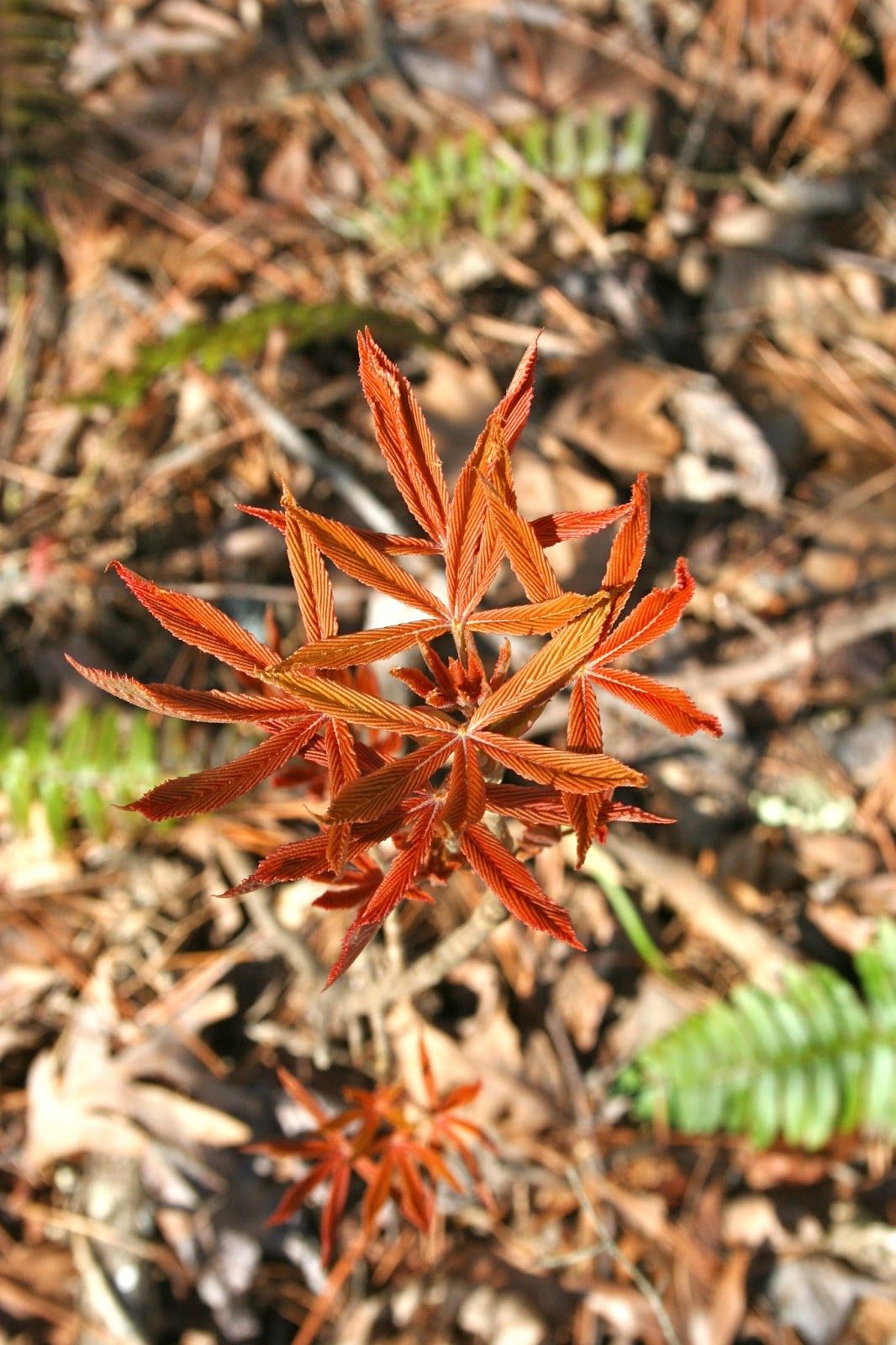
While scanning the bottomland for the telltale blossom of the anemone, the wanderer observed other signs of spring. Dozens of these striking stems dotted the floodplain along the stream, teasing the observer with just a hint of their true identity.  


A bit farther along, their intrigue abruptly ended when this complex matrix of 5 pronged leaves gracefully unfurled. The red buckeye would be well represented in these parts this year! 


Suddenly, and at last, the rue anemone! Invisible for a time in the sun-dappled expanse of browns and tans and faded browns on the forest floor, but glaringly obvious once the image of the first flits across the visual cortex of the seeker, several individuals now spring into view.


Judging from the small numbers and the early stage of the blossoms, we caught these lithe beauties just after their initial emergence. Whether blessing, good luck or karma, we're grateful for the cosmic juxtaposition which allowed us to complete our trifecta of hepatica, anemone and spring beauty with rather little effort on this gorgeous afternoon.


A parting look, then out of the woods for a while. We'll have to settle for the domesticated spring blossoms for a few days until we can slip away for another walk on the wild side.

Friday, March 8, 2013

Snapshots of a Snapper with the Griffin Scholars

Yesterday's nature excursion with the young scholars of Griffin Academy was blessed by brilliant sunshine, not too brisk temperatures and tremendously enthusiastic adventurers. Armed with nets and plastic containers, our intrepid nature explorers captured an impressive array of dragonfly nymphs, tadpoles, minnows and snails, along with gobs of slimy green hair-like pond scum or filamentous algae, most likely colonies of spirogyra.
Our bold young Griffins also showed off their photography skills when confronted with a rather large and apparently rather dead common snapping turtle. 


Chelydra serpentina is North Carolina's largest native turtle, and this fifteen-pounder had apparently succumbed to the cold of winter or perhaps old age.


Inappropriate attire notwithstanding, Mr. Jimmy gingerly retrieved the carcass from the water's edge so that the students could have a closer look, as they documented the procedure with a handy-dandy iPhone camera.


Imagine their suprise when the decidedly not-dead reptile suffiently shook off its late-winter torpor to demonstrate for everyone the origins of its common name by attempting to carve up the toe of Mr. Jimmy's entirely inappropriate footwear!


With the "snapper" re-oriented away from all the nearby toes and ankles, everyone took a moment to appreciate the awesomeness of this fully alive and operational predator from the depths.


A truly awesome creature, extremely well-adapted to its aquatic environment. Its impressive tail was nearly as long as its carapace, and more than one child compared it to a dinosaur's. The head was massive, with really cool-looking eyes, and mouth exceedingly well-equipped for grabbing and holding slippery prey. The shell sported a healthy growth of algae, which would obviously serve its host well in the business of camouflage on the bottom of the pond.

 
Our budding young scientists thoroughly exhausted Mr. Jimmy's knowledge of these extraordinary creatures, and left him with plenty of questions to be researched later.


Presumably much relieved to be finished with its fifteen minutes of fame, the subject of our brief but enthusiastic examination hunkered back down into the mucky bottom from whence it was so unceremoniously extracted, most likely resuming the not quite finished business of its long winter's nap. 


Farewell, old turtle!